Use exploded views, inspect wear before re-lubing, and do not turn an unknown diff into a tuning experiment.
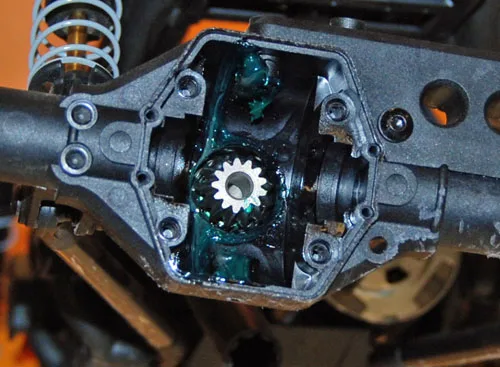
Manufacturer workshop image: open rear axle exposing greased bevel-gear area.
Specific Axial axle; lubricant type, amount and service order must follow the relevant manual.
Axial Adventure; Bender's AX10 Ridgecrest Stage 3 (photographer not identified) · Manufacturer copyright; permission required before public release
Photo credit & source ↗View the teaching schematic
Goal
Disconnect and remove the battery before opening a drivetrain. Find the exact manual and exploded view first, then clear a bench area with separate containers for front, rear and center components. Differential layouts, seals, gears and lubricants vary widely; “RC diff service” is not one procedure. Take a photo of the exterior and note the vehicle end before removing a cover.
Document before cleaning
Open only as far as the manual instructs. Inspect ring and pinion teeth, cross pins, outdrives, seals, bearings and the case for broken, chipped or unusually worn surfaces. Traxxas’s crawler preparation guide tells owners to inspect ring and pinion gears for broken or excessive tooth wear, check bearings for corrosion and smooth action, and clean before re-lubricating the correct assembly. Traxxas crawler preparation This supports inspection, not a universal grease quantity or fluid recommendation.
Inspect and reassemble
Before cleaning, document what you found: “rear diff: grease present, no chipped teeth, left bearing rough” is a valid baseline. If the manual identifies a differential fluid, grease or sealed unit, use that exact documentation rather than transferring a forum setting from another chassis. Keep front, rear and center parts separated. A reversed or mixed component can create a new fault that looks like a tuning problem.
Clean old debris from the case and gear teeth with a method approved for the materials and seals in the manual. Do not energize the vehicle on the bench while fingers, tools or loose parts are in the drivetrain. Reassemble in the manual’s order, ensuring seals and covers seat correctly. Turn the assembly by hand at each stage; if it binds before the cover is tightened, stop and revisit part orientation rather than applying more force.
Hypothetical example: a crawler diff cover is opened after a wet season. The gears have no broken teeth, but one bearing feels rough and there is contamination in the case. The responsible result is to service the contamination and replace the unsuitable bearing according to the parts diagram, then confirm smooth hand rotation—not to add a heavier lubricant and call the noise fixed. Stop for stripped teeth, cracked cases, missing pins, persistent binding, or an uncertain gear stack. If the model has selectable locking hardware, use its specific manual and verify its operation only with the vehicle secured and clear of hands. The goal is a documented, smooth baseline before any later setup change.
Reassembly check
If a unit is sealed and the manual offers no internal procedure, do not invent one from a similar vehicle. Record the noise and resistance, then use official support or replacement guidance. After reassembly, rotate outputs through several turns before refitting wheels and repeat the original free-roll check. A new sound after service is a reason to stop, not a reason for a high-throttle test.
Leave with a useful record.
This is a reading aid, not a safety certification. Checks stay only on this page and reset when you reload.
Sources & scope
Primary references checked September 19, 2026. These dates describe source review, not publication of this site. Examples labelled hypothetical or illustrative are not tests.
Traxxas — Get Trail Ready for RC Crawling Season
Supports: inspect ring/pinion wear and bearing condition; clean and re-lubricate opened drivetrain assemblies.
Limit: Official indexed article text checked; direct retrieval unavailable. TRX-4-specific inspection context, not universal lubrication or powered service instructions.
Source publication: 2023-05-02 · Checked: 2026-09-19