Buggy
Open wheels, a compact body and typically a rear wing. Often the starting point for off-road racing.
Before you choose
Club class, track surface, legal tires, 2WD versus 4WD, and local spares.
Race it. Bash it. Crawl it. Build it. Start with the driving you enjoy, then compare the shape, scale and drivetrain separately.
12 vehicle families and size groupings
Open wheels, a compact body and typically a rear wing. Often the starting point for off-road racing.
Before you choose
Club class, track surface, legal tires, 2WD versus 4WD, and local spares.
A buggy-related layout with a wider truck stance and larger tires. The label alone does not tell you whether it is a race kit or a basher.
Before you choose
Chassis specification, ground clearance, wheel/hex fit, and where you can run it.
A truck-shaped off-road platform with exposed wheels. Check the specific class and platform rather than assuming every truck shares a chassis.
Before you choose
Your club’s class rules, tire choice, track width and parts availability.
A full-width truck body with covered wheels and a recognizable short-course silhouette. Race and recreational setups coexist.
Before you choose
Track class, body clearance, bumpers, tire diameter and wheel offset.
Big tires and a tall stance are the visual signatures. “Bashing” describes recreational driving, not permission to jump beyond a model’s limits.
Before you choose
Usable space, safe run-off, ground clearance, stability and repair access.
Low road-going bodywork for smoother surfaces. A race car’s class rules matter as much as its appearance.
Before you choose
Track surface, class, tire rules, actual width and wheelbase.
A sliding-focused road car where steering setup and the tire/surface pairing shape the experience.
Before you choose
The local drift surface and tire convention, drive layout and steering clearance.
Road-car styling adapted to mixed-surface driving. Real capability depends on ground clearance and the exact chassis.
Before you choose
Surface roughness, tire clearance, debris protection and suspension travel.
Two specialist racing directions: straight-line acceleration or repeated corners. They are not the same setup or one shared class.
Before you choose
Venue rules, permitted tires, run-off space and the correct discipline-specific guide.
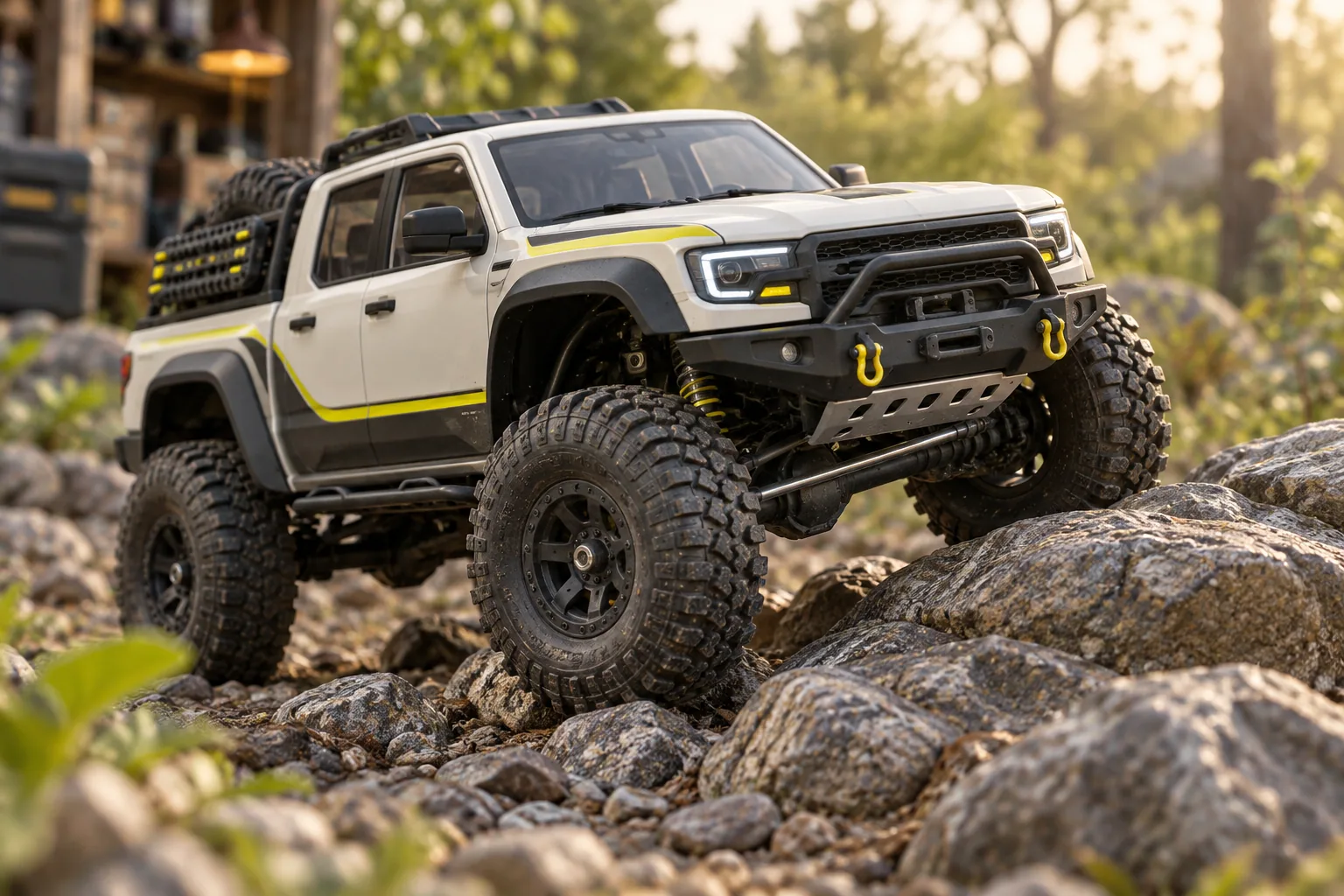
Slow obstacle work can prioritize capability, scale realism, or both. Competition crawlers and detailed trail builds have different goals.
Before you choose
Obstacle size, gearing, articulation, turning needs and any local competition rules.
A different branch of the crawling family that blends obstacles with more dynamic driving. Not simply a slow trail truck with a bigger motor.
Before you choose
Terrain, chassis intent, safe space and the specific platform’s limits.
Size labels rather than one body style: small buggies, crawlers and road cars can behave very differently.
Before you choose
Actual dimensions and obstacle size. A small chassis can turn a room into an interesting course.
Crawler distinctions follow Axial’s explanation of crawler families ↗. Descriptions are editorial orientation, not a specification for every model.