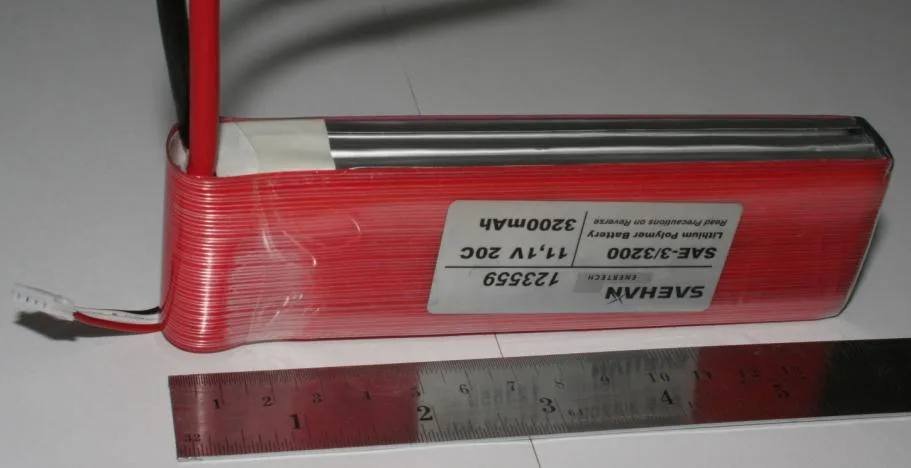
A LiPo pack. Charging notes in this edition do not glamorize unsafe practice.
Chaagii 0817 · CC BY-SA 3.0
Photo credit & source ↗From the September 2026 research edition. Product details and prices are dated source records; confirm the exact model and manual before buying or making changes.
Walk down any RC battery aisle, real or online, and you will see C ratings climbing: 50C, 75C, 100C, sometimes higher. It is easy to assume a bigger number means a stronger pack. Unfortunately, the evidence available suggests that the number printed on the label tells you surprisingly little about how a pack will actually perform.
The spec that seems to matter much more is one most labels leave off entirely: internal resistance, usually shortened to IR. In this post we explain what a C rating is supposed to mean, what internal resistance is, why it drives the "punch" you feel on the throttle, and how to compare packs more sensibly.
One honest caveat up front: the best independent evidence we found comes from enthusiast testers, not accredited laboratories. That still tells us a lot, but we will be clear about its limits.
Quick answer
- A C rating is a claimed discharge rate relative to capacity. 1C for a 5000 mAh pack is 5 A.
- An enthusiast test of more than 28 packs by RCexplained found labeled C ratings predicted real performance poorly, while measured internal resistance predicted it well.
- Higher internal resistance means more voltage sag and more heat under load.
- Compare packs by measured per-cell IR and brand consistency, not the C number on the label.
- The evidence is from enthusiasts, not labs. Treat the exact figures as indicative.
What a C rating is supposed to mean
"C" is shorthand for a rate relative to the pack's capacity. Horizon Hobby and Gens Ace both use this wording in their charging guidance: 1C is a current in amps equal to the capacity in amp-hours. For a 5000 mAh (5 Ah) pack:
| Rate | Current for a 5000 mAh pack |
|---|---|
| 1C | 5 A |
| 5C | 25 A |
| 30C | 150 A |
| 100C | 500 A |
So a "100C" 5000 mAh label implies the pack can deliver 500 A. That is an enormous current for a hobby battery, and it is one reason experienced hobbyists raise an eyebrow at very high labels.
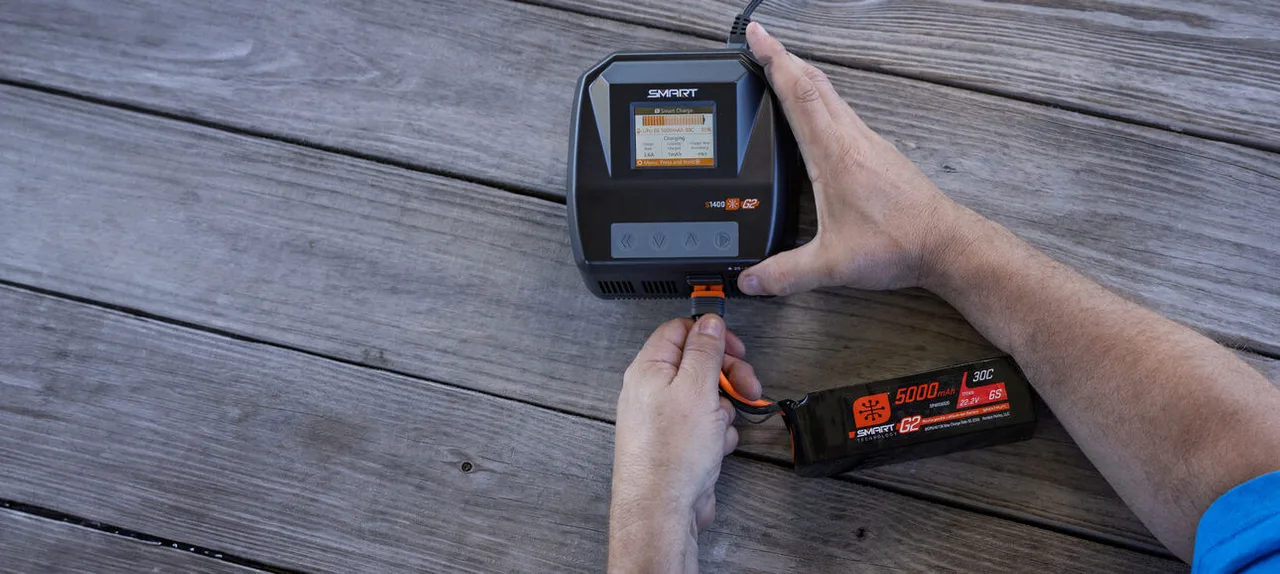
The same "C" language is used for charging. Horizon's lithium safety sheet says to charge at no more than 1C unless the maker says otherwise. Some packs are rated higher. Spektrum rates its SPMX53S30 3S 5000 mAh Smart G2 pack for up to 5C charge. Always use the charge rate on your own pack's label or manual.
There is no C-rating test standard cited by the makers in the sources we reviewed, and no maker explained how its numbers are derived. That gap is where the trouble starts.
What internal resistance is
Every battery resists the flow of current a little. That resistance, measured in milliohms (mΩ), lives inside the cells, their tabs and their internal connections. It has two effects you can feel.
1. Voltage sag
Ohm's law says voltage drop equals current times resistance (V = I × R). RC Helicopter Fun, an enthusiast site, gives an example: pushing 100 A through 18 mΩ produces a 1.8 V drop. The motor sees less voltage the moment you punch the throttle, which means less speed and acceleration than the pack's resting voltage suggests. Heavy sag can also trip the ESC's low-voltage cutoff early.
2. Heat
The energy lost to resistance becomes heat inside the pack. More resistance at the same current means a hotter battery. Heat matters because Horizon's safety sheet says to keep a pack below 160 °F while discharging.
IR changes over time
RC Helicopter Fun also notes that IR rises as packs age. That means a pack that felt strong when new can feel weaker over time, because it sags more under load.
What an independent (enthusiast) test found
The most detailed comparison we found was published on April 28, 2026, by RCexplained, credited to the "RCe Team." It is an enthusiast project, not an accredited lab test, and the main article does not name the brands it tested. With those limits in mind, here is what they reported:
- They tested more than 28 packs using IR measurements and load tests.
- Labeled C rating correlated only weakly with measured performance (R² of about 0.145).
- Measured IR correlated strongly with performance (R² of about 0.80–0.83).
- The "real" C ratings they calculated ranged from about 12C to 36C.
- Many packs delivered less than 20% of their labeled rating, and most delivered less than 50%.
- In one case, a 100C pack from a given maker did worse than a 45C pack from the same maker.
A quick note on R² for non-statisticians: it runs from 0 to 1 and describes how well one number tracks another. At about 0.145, the label barely tracked real results in this data set. At about 0.8, IR tracked them closely.
RC Helicopter Fun reaches a similar conclusion by a different route. Its author offers a rule-of-thumb formula for estimating a "realistic" C rating from IR. In his example, a pack labeled "80C" worked out to about 30C, and he describes claims much above 40C as "marketing." That is one writer's estimate method, not a standard, but it points the same way.
How much weight should you give this?
Enthusiast tests can vary in method, equipment and sample size, and we found no accredited lab data to check them against. They are still the best evidence available in our research, and both point to the same conclusion: the label is a weak guide, and resistance is a strong one.
We also looked for independent verification of branded rating schemes. For example, SMC Racing markets "True Spec" ratings. We did not find an SMC definition of the term or any independent measurement of it, and a 2019 Big Squid RC review of an SMC pack did not include IR data. We cannot say whether those ratings are more accurate.
How to compare packs more sensibly
Look at measured per-cell IR
Where IR figures are available, from a reviewer or your own charger if it has an IR readout, compare them per cell and at similar temperatures. Lower per-cell IR generally means less sag and less heat at the same current. We are not giving target numbers here, because the sources we reviewed do not publish agreed thresholds and readings vary between meters.
Favor consistency
The RCexplained result that one maker's 100C pack underperformed its own 45C pack is a reminder that labels may not be comparable even within a brand. Reviews that measure IR across several packs from the same line are more useful than the C number.
Track your own packs over time
Because IR rises with age, logging readings from a new pack gives you a baseline. A pack whose IR has climbed noticeably, or whose cells no longer match each other, is likely to feel weaker.
Don't forget the rest of the power path
The battery is only part of the story. Connectors and wire have resistance and current limits too. Holybro, citing genuine Amass specifications, lists the XT60 at 30 A continuous and 60 A burst on 12 AWG wire. That is well below the "60 amps" many people assume from the name. Most RC connector makers publish no amp rating at all, and the figures that circulate often come from retailers. A great pack cannot make up for an undersized plug.
What to watch out for
- Buying on the C number alone. In the RCexplained data, it barely predicted performance.
- Assuming a higher label means a safer margin. If real ratings run far below the label, a pack may be working harder than you think, and it can get hot. Watch temperatures.
- Comparing IR readings taken differently. Temperature and meter type affect readings, so compare like with like.
- Ignoring age. A two-year-old "high C" pack may sag more than a new, modestly rated one.
- Charging at the label's high C-rate by default. Use the charge rate your pack's maker specifies, and 1C when in doubt, per Horizon's safety sheet.
FAQ
Are all C ratings fake?
Not necessarily fake, but in the enthusiast test by RCexplained, most packs delivered less than half their labeled rating, and the label correlated weakly with real performance. Treat the label as marketing until a measurement says otherwise.
What is a good internal resistance number?
Lower is better, but we are not quoting targets because the sources we reviewed give no agreed thresholds, and readings vary by charger and temperature. Compare packs measured the same way.
Why does my battery feel weaker than it used to?
One common reason is rising internal resistance, which RC Helicopter Fun notes increases with age. More resistance means more voltage sag under load.
Does a higher C rating make my car faster?
Only if the pack actually delivers more current with less sag. Measured IR is a better predictor of that than the printed C rating, according to the RCexplained data.
Is the RCexplained test a lab test?
No. It is an enthusiast test of more than 28 packs with IR measurements and load tests, and it did not name the brands in the main article. It is useful evidence, not a certified standard.
Sources
- RCexplained (radiocontrolinfo.com): LiPo C rating myth, real performance test
- RC Helicopter Fun: LiPo internal resistance
- Spektrum: Lithium Battery Safety (PDF)
- Gens Ace (Genspow EU): LiPo Battery Guide
- Spektrum: 11.1V 5000mAh 3S 30C Smart G2 LiPo (SPMX53S30)
- Big Squid RC: SMC Racing True Spec DV 4S 9400mAh 75C review
- Holybro: Connector and wire rating