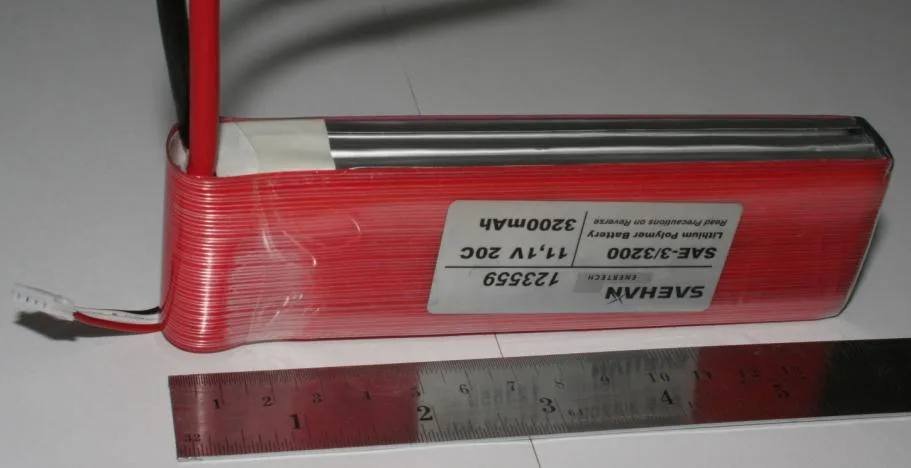
An older RC-model LiPo pack photographed by Achimd. A label-reading example, not a current battery recommendation.
Achimd · Public domain
Photo credit & source ↗From the September 2026 research edition. Product details and prices are dated source records; confirm the exact model and manual before buying or making changes.
If you have just bought your first brushless RC car, there is a good chance the battery and charger were not in the box. Traxxas's own product pages for models like the Slash 4X4 Brushless, the Stampede 4X4 Brushless and the Maxx list them as not included. Now you are staring at a wall of packs labeled 2S, 3S, 5000 mAh and 50C, and wondering which numbers matter.
This guide covers the basics: what the voltage numbers mean, the voltages you should never go below or above, how to store a pack when you are not driving, and the habits that help a lithium polymer (LiPo) battery last. We will also be upfront about one thing that confuses a lot of people: battery makers do not agree on a single "storage voltage."
Speed and charging topics get their own posts in this series. Here we stick to what every LiPo owner should know before the first charge.
Key takeaways
- A LiPo cell is 3.7 V nominal and 4.2 V when fully charged. "S" means cells in series, so 2S is 7.4 V nominal and 3S is 11.1 V.
- Do not run packs too low. Traxxas ESCs with Low-Voltage Detection warn below 3.2 V per cell, and Gens Ace says never go below 3 V per cell under load.
- Store LiPo packs partly charged. Makers give different targets, from 3.6 V to 3.9 V per cell, so follow the one for your pack.
- LiHV packs charge to 4.35 V per cell and need the LiHV setting to use their full capacity.
- Stop using swollen or damaged packs, and dispose of them according to local rules.
What the numbers on a LiPo label mean
Cells and voltage (the "S" number)
A LiPo pack is built from individual cells. Each LiPo cell is 3.7 V nominal, according to both Traxxas and Gens Ace. "Nominal" is the average voltage during use, not the voltage when full or empty. Packs wire cells in series (the "S"), which adds their voltages:
| Pack | Cells | Nominal voltage | Full charge (4.2 V/cell) |
|---|---|---|---|
| 2S LiPo | 2 | 7.4 V | 8.4 V |
| 3S LiPo | 3 | 11.1 V | 12.6 V |
| 4S LiPo | 4 | 14.8 V | 16.8 V |
| 6S LiPo | 6 | 22.2 V | 25.2 V |
Nominal figures for 2S to 4S come from Traxxas. The full-charge column uses the 4.2 V per cell maximum that Gens Ace lists, multiplied by the cell count.
More voltage generally means more speed from the same motor. That is why many trucks advertise one speed on 2S and a higher one on 3S. Always check which cell counts your ESC (electronic speed control) supports. The Slash 4X4 Brushless, for example, is listed for 2S or 3S LiPo and does not support NiMH.
Capacity (mAh) and energy (Wh)
Capacity in milliamp-hours (mAh) tells you roughly how much charge the pack holds. Bigger numbers usually mean longer run times, along with more weight and a bigger physical size. Energy in watt-hours (Wh) combines voltage and capacity. Spektrum lists its 3S 5000 mAh Smart G2 pack at 11.1 V and 55.5 Wh, which is 3.7 V × 3 cells × 5 Ah. Watt-hours matter most when you fly or ship batteries. We cover that in our travel and shipping post.
C rating
The C rating is a discharge rating relative to capacity. 1C equals a current in amps that matches the capacity in amp-hours, so 1C for a 5000 mAh pack is 5 A. Labeled C ratings are widely considered unreliable. Our post on C ratings and internal resistance explains why.
How LiPo compares with NiMH
Many ready-to-run (RTR) starter kits still include nickel-metal hydride (NiMH) packs. The Traxxas Slash 2WD XL-5 with battery comes with a 3000 mAh 8.4 V NiMH iD pack. The ARRMA Gorgon bundle includes an 8.4 V 3300 mAh Spektrum Smart NiMH pack. NiMH cells are 1.2 V each, so a 7-cell pack is 8.4 V.
Traxxas says LiPo has greater energy density than NiMH and sustains a higher voltage for more of each run. The trade-off is that LiPo packs need more careful handling. That includes a LiPo-specific balance charger: Traxxas warns never to charge a LiPo on a NiMH charger or NiMH mode.
LiHV: the "high-voltage" variant
LiHV (high-voltage lithium polymer) packs look like normal LiPos but have different limits. According to cell maker Grepow:
- Full charge is 4.35 V per cell, not 4.2 V.
- Nominal voltage is 3.8 V per cell.
- They hold roughly 10% more energy than a standard LiPo.
- Charging a LiHV pack on a standard 4.2 V LiPo setting leaves capacity unused.
The reverse is the mistake to avoid. Never use a LiHV setting on a standard LiPo, because that would charge it past its 4.2 V rated maximum. Check the label and match the charger mode to the chemistry every time.
The voltages that matter
Don't run a pack too low
Draining a LiPo too far is one of the fastest ways to ruin it. Traxxas says over-discharging an iD LiPo "will cause irreparable damage and may cause battery failure." The guidance varies slightly by source:
| Source | Low-voltage guidance |
|---|---|
| Gens Ace | "Never discharge battery to a level below 3V per cell under load" |
| Horizon Hobby / TRI safety sheet | Each cell must be at least 3 V before charging or use |
| Traxxas | ESC Low-Voltage Detection warns below 3.2 V per cell; turn LVD on for LiPo |
| Tattu (Gens Ace UAS packs) and Grepow (LiHV) | 3.5 V per cell recommended for longevity |
The practical lesson: turn on your ESC's low-voltage cutoff whenever you run LiPo. Traxxas lists the XL-5, VXL-3s, VXL-3m and MXL-6s ESCs as having LVD. When the car slows noticeably or the cutoff kicks in, stop driving. Do not "just do one more lap."
Temperature limits while charging and driving
Horizon Hobby's lithium battery safety sheet for Spektrum packs gives these limits:
- Charge at no more than 1C unless the battery maker says otherwise.
- Do not charge below 40 °F (4 °C).
- Do not charge a pack that is hot to the touch (above 100 °F).
- Keep the pack below 160 °F while discharging.
- Store at 40–120 °F (4–49 °C).
Gens Ace adds that you should never charge below freezing or while the pack is hot. If a pack comes off the car warm, let it cool before it goes on the charger.
Storage voltage: makers disagree
Leaving a LiPo fully charged for days, or completely flat, is widely discouraged. Every major source recommends storing a partly charged pack. They do not agree on the exact number:
| Maker / source | Storage guidance | Notes |
|---|---|---|
| Horizon Hobby (TRI LiPo safety sheet) | About 1/2 capacity, or 3.8 V per cell | Standard LiPo |
| Spektrum Smart G2 packs | Pack discharges itself to 3.90 V per cell after 72 hours unused | Default; time and voltage adjustable, or can be turned off with a Smart charger or checker |
| Gens Ace / Genspow | 3.6–3.9 V per cell for storage over 3 months | At 23 ± 5 °C and 65 ± 20% relative humidity |
| Traxxas | "Partially charged" (about 50%) using the charger's Storage mode | No per-cell number given on the pages checked |
| Grepow (LiHV) | 3.80–3.85 V per cell | For LiHV packs |
There is no single industry figure. The ranges overlap, though. Most standard LiPo guidance lands somewhere around 3.8–3.9 V per cell, and most hobby chargers have a "storage" mode that does the work for you. If your pack's maker publishes a number, use theirs.
How long is "storage"? Spektrum's Smart G2 packs start discharging to storage after 72 hours by default, and Gens Ace's figure applies to storage longer than three months. A sensible habit is to put packs into storage mode if you will not drive within a few days.
NiMH is different. Traxxas says NiMH packs "do not need to be charged before storage."
How long do LiPo packs last?
None of the maker sources we reviewed gives a single cycle-count lifespan for RC LiPo packs, so be wary of anyone who quotes one confidently. What the sources do make clear is which habits shorten a pack's life:
- Over-discharging. Traxxas calls the damage irreparable.
- Heat. Horizon sets limits for charging, driving and storage temperatures (see above).
- Storing at the wrong charge level. This is why storage modes exist.
- Age and use. RC Helicopter Fun, an enthusiast site, notes that internal resistance rises as packs age. Higher resistance means more voltage sag and more heat under load.
Signs a pack is at the end of its life include noticeably weaker punch, shorter runs and swelling. Horizon's safety sheet is direct about damaged packs: "Discontinue use and dispose of damaged or swollen batteries immediately," following local, state and national law.
Common mistakes
- Charging LiPo on a NiMH mode or charger. Traxxas warns this can cause explosion, fire and injury.
- Leaving the low-voltage cutoff off. Many ESCs support both NiMH and LiPo, so make sure LiPo cutoff is selected.
- Storing packs full. Use storage mode between sessions.
- Charging a hot pack straight after a run. Let it cool first.
- Mixing up LiPo and LiHV settings. A LiPo on a LiHV setting is overcharged.
- Keeping a puffy pack "because it still works." Makers say to stop using swollen packs.
- Throwing old packs in the trash. PHMSA says lithium batteries should never go in the trash or general recycling.
FAQ
What is the best storage voltage for an RC LiPo?
Makers disagree. Horizon's safety sheet says 3.8 V per cell, Spektrum Smart G2 packs self-store to 3.90 V, and Gens Ace gives a 3.6–3.9 V range for long storage. Use your pack maker's figure or your charger's storage mode.
Is 2S or 3S better for a beginner?
Start with whatever your vehicle's manual recommends. Higher voltage adds speed, which can be harder to control while you learn. Several beginner RTRs, such as the Traxxas Mini Maxx BL-2s, ship with a 2S pack included.
Can I charge a LiPo with my NiMH charger?
No. Traxxas says never to charge a LiPo using a NiMH charger or NiMH mode. Use a LiPo balance charger.
How low can I run my LiPo?
Gens Ace says never below 3 V per cell under load, and Traxxas ESCs warn below 3.2 V per cell. Some sources suggest stopping around 3.5 V per cell for better longevity. Keep your ESC's LiPo cutoff on.
My pack is slightly puffy. Is it OK?
Horizon Hobby says to stop using and dispose of swollen or damaged packs immediately, following local law. See our charging safety post for disposal guidance.
Sources
- Traxxas: Battery Basics
- Traxxas: LiPo Batteries
- Gens Ace (Genspow EU): LiPo Battery Guide
- Grepow: LiPo vs LiHV battery
- Horizon Hobby: TRI LiPo Battery Safety Sheet (PDF)
- Horizon Hobby: Smart G2 Battery and Charger FAQ (PDF)
- Spektrum: Lithium Battery Safety (PDF)
- Spektrum: 11.1V 5000mAh 3S 30C Smart G2 LiPo (SPMX53S30)
- RC Helicopter Fun: LiPo internal resistance
- PHMSA: Lithium Batteries
- Traxxas: Slash 4X4 Brushless
- Traxxas: Stampede 4X4 Brushless
- Traxxas: Maxx
- Traxxas: Slash 2WD XL-5 with battery
- Traxxas: Mini Maxx BL-2s
- Horizon Hobby: ARRMA Gorgon with battery and charger
.jpg)