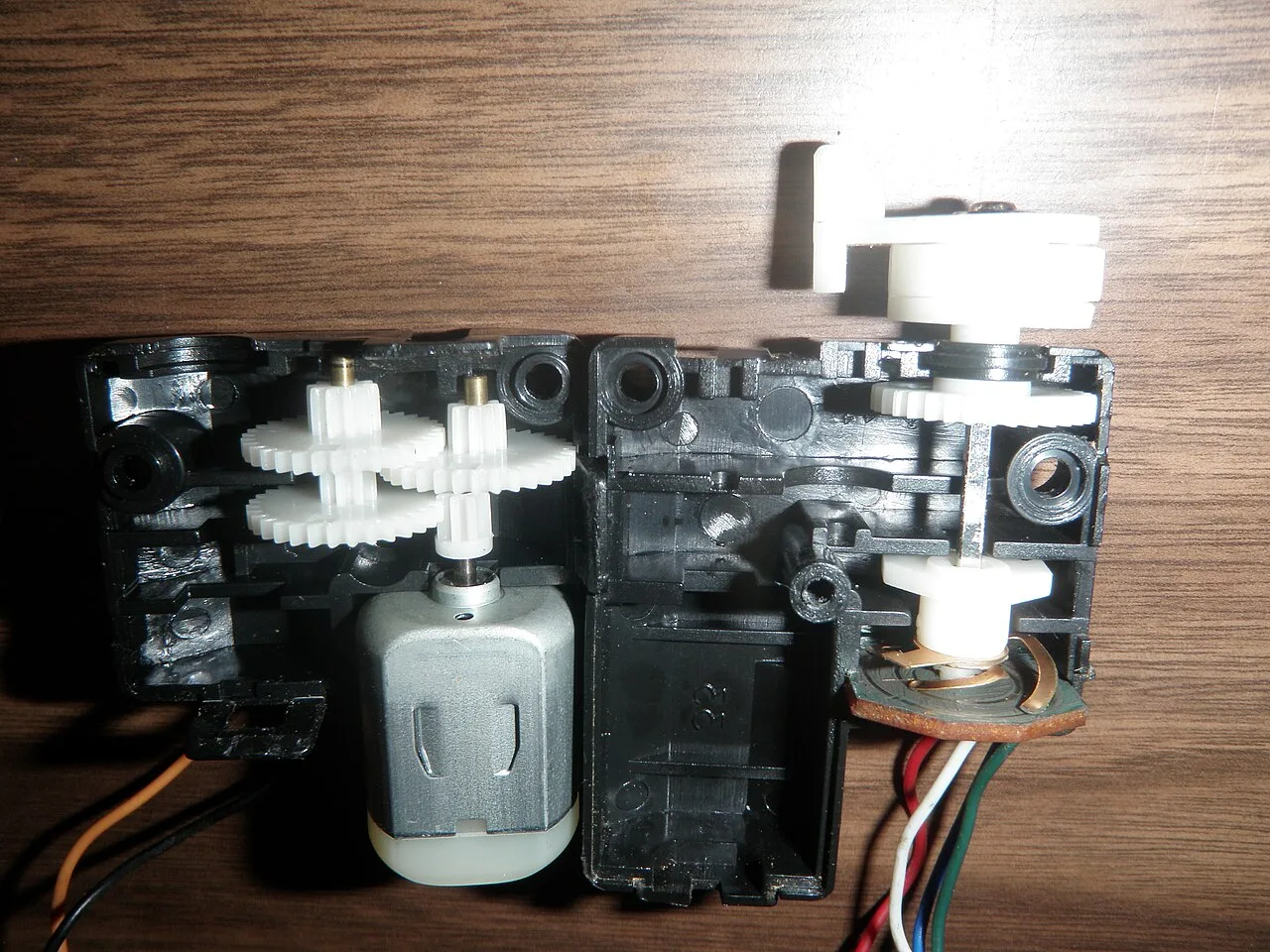
Inside an RC-car steering servo, photographed by Jstapko. The exposed assembly is explanatory context, not an instruction to open a powered servo.
Jstapko · CC BY-SA 3.0
Photo credit & source ↗From the September 2026 research edition. Product details and prices are dated source records; confirm the exact model and manual before buying or making changes.
If your RC truck turns lazily, fails to hold a line over bumps, or its steering "gives up" when a front tire hits a rock, the servo is often to blame. The steering servo is a small motor-and-gearbox unit that turns your front wheels when you move the wheel on your radio. Stock servos are frequently the first part hobbyists upgrade.
But bigger is not automatically better. A powerful servo can overload your electronics and cause the receiver to reset mid-run. This guide explains how to read torque and speed ratings, why the BEC (the circuit that powers your servo) matters, how Traxxas and Arrma size servos for their own vehicles, and what current popular servos offer.
Key takeaways
- Torque is measured in ounce-inches (oz-in); speed is measured in seconds to turn 60 degrees. Lower seconds means faster.
- Both torque and speed rise with voltage, so always compare ratings at the same voltage.
- High-torque servos can draw more power than an ESC's built-in BEC supplies. Castle Creations says an external BEC "can provide stable power" if your servo causes brownouts.
- Traxxas's servo guide maps servo sizes to vehicles, from micro servos for the TRX-4m to 450–650 oz-in servos for the Maxx, X-Maxx and XRT.
- Retailer specs can conflict. Two retailers list different 7.4 V torque figures for the Savox SB-2290SG.
Reading servo ratings
Torque
Traxxas explains that "Servo torque is measured in ounce-inches and indicates the force" at a 1-inch lever arm. In plain terms, a 500 oz-in servo can push with 500 ounces of force one inch from the center of its output shaft. Some manufacturers also give kg-cm; Arrma, for example, lists its S905 servo as 500 oz-in (36 kg-cm) at 6 V.
More torque helps a servo turn wide, heavy or grippy tires, and hold them in place when the terrain pushes back.
Speed
Speed is listed as the time in seconds the servo takes to rotate 60 degrees. A 0.08 s servo is roughly twice as quick as a 0.16 s servo. Faster servos make steering feel more immediate, which racers value, and Big Squid RC found that faster servos made Spektrum's AVC stability system work better.
Voltage
Torque and speed both increase as voltage increases. The Savox SB-2290SG shows this clearly (figures from servos.net):
| Voltage | Torque | Speed (per 60°) |
|---|---|---|
| 6.0 V | 624.9 oz-in | 0.16 s |
| 7.4 V | 763.8 oz-in | 0.13 s |
| 8.4 V | 972.1 oz-in | 0.11 s |
"HV" (high-voltage) servos are rated to around 7.4–8.4 V. Always check the maximum voltage printed in your servo's specifications and never feed it more than that. If a spec sheet gives torque at 8.4 V, but your BEC supplies 6 V, expect performance closer to the 6 V numbers.
BECs, brownouts and why power matters
A BEC (battery eliminator circuit) converts battery voltage down to a level the receiver and servo can use. Most ESCs have one built in. A high-torque servo under load can draw more current than that internal BEC supplies, causing a brownout: voltage sags and the receiver may glitch or reset.
Castle Creations says external BECs "can help prevent brownouts, improve servo performance, and reduce strain on the ESC's internal power system," and that they are especially useful with "high-voltage LiPo batteries, high-torque digital servos." Its advice is direct: "If your steering servo causes brownouts or receiver resets, an external BEC can provide stable power."
Brownouts are more than an annoyance. Spektrum's SR6200A receiver manual says failsafe does not trigger on low receiver voltage or power loss, and gives an operating range of 3.5–9.6 V. So a brownout could cause a loss of control that failsafe will not catch. That is a reasonable inference from the manual's wording rather than a Spektrum statement.
Manufacturers also flag BEC needs for specific servos:
- Traxxas says its 2255 and 2280 brushless servos need the "High-Power BEC Kit" when installed in the TRX-4 or TRX-6.
- Reefs RC says of its Triple5 V2: "BEC Recommended for best performance."
Castle Creations BEC options
Prices as listed by Castle Creations as of September 17, 2026; prices change.
| Model | Max output | Max input | Price |
|---|---|---|---|
| CC BEC Nano | 6 A | 4S | $24.95 |
| CC BEC 10A | 10 A | 6S | Not listed |
| CC BEC 2.0 | 14–15 A | 14S | Up to $56.95 (Waterproof version) |
| CC BEC Pro | 20 A | 12S | Not listed |
When choosing, match the BEC's output voltage to your servo's rating and its input rating to your battery.
How manufacturers size servos
Traxxas's servo upgrade guide (published January 26, 2024) is a helpful map of what size of servo each type of vehicle uses:
| Vehicle type (Traxxas examples) | Servo class | Traxxas servos |
|---|---|---|
| TRX-4m micro crawler | Micro/sub-micro | 2065R |
| 1/16 models | Micro/sub-micro | 2080R |
| Bandit, Rustler, Stampede, Slash | Standard | 2075R/X; also 2275 (347 oz-in), 2250 (330 oz-in), 2270 (236 oz-in) |
| TRX-4 / TRX-6 crawlers | 236–400 oz-in | 2255 brushless (400 oz-in) |
| Maxx, X-Maxx, XRT | Large-scale, 450–650 oz-in | 2085X (450 oz-in), 2085R (650 oz-in) |
Traxxas also offers the 2280 brushless servo (600 oz-in at 6 V, 700+ at 7.4 V). Both the 2255 and 2280 need the High-Power BEC Kit when fitted to the TRX-4 or TRX-6, and Traxxas describes both as waterproof. The guide also states, "All Traxxas metal-gear servos are fully waterproof, not merely water resistant."
Arrma provides another reference point: it fits a 500 oz-in servo (the S905, rated 6.0–8.4 V) to its 8S Outcast.
Popular aftermarket servos compared
Prices are from the listed retailer as of September 17, 2026, unless noted. Prices change.
| Servo | Torque | Speed (per 60°) | Voltage | Price | Notes |
|---|---|---|---|---|---|
| Savox SB-2290SG (brushless, steel gear) | 624.9 oz-in @ 6 V; 763.8 @ 7.4 V*; 972.1 @ 8.4 V | 0.16 / 0.13 / 0.11 s | 6–8.4 V | $163.89 sale ($203.49 regular), servos.net | 81 g, aluminium case, not waterproof |
| ProTek 170SBL Black Label (brushless, HV) | 458 oz-in @ 6 V; 535 @ 7.4 V | 0.09 / 0.08 s | Up to 7.4 V | $175.99 ($187.99 regular), servos.net | Aluminium case, 150 and 300 mm leads |
| Reefs Triple5 V2 | 500 oz-in @ 6 V; 555 @ 7.4 V | 0.20 / 0.17 s | 6–7.4 V | $138.99, reefsrc.com | "WATERPROOF (Not a Submarine)", steel gears, 25T; listed as discontinued |
| Traxxas 2085X Maxx-Duty | 450 oz-in | Not stated by Traxxas | Not stated | About $100 street in 2017 (Big Squid RC) | Metal gears; for Maxx, X-Maxx, XRT |
*See the conflict note below.
The Savox torque conflict
servos.net lists the SB-2290SG at 763.8 oz-in at 7.4 V. A product title at another retailer, RCSuperstore, shows "694 oz/in @ 7.4V." We could not retrieve Savox's official specification sheet, so we cannot say which is correct. If torque at 7.4 V is the deciding factor for you, check Savox's own documentation before buying.
Speed vs. torque: an example trade-off
The ProTek 170SBL is quicker (0.08 s at 7.4 V) but lists less torque (535 oz-in) than the Savox SB-2290SG at the same voltage. The Reefs Triple5 V2 sits in between on torque but is slower (0.17 s at 7.4 V). A racer on a smooth track may prioritise speed; a heavy basher or crawler may prioritise torque. Also note the ProTek's voltage limit of 7.4 V: it should not be run on an 8.4 V BEC setting.
A simple way to choose
- Start with your vehicle class. Use the Traxxas mapping above as a guide for the torque range similar vehicles use.
- Check the physical size (micro, standard, large-scale) and the output spline, such as Reefs' 25T, so it fits your servo horn.
- Match voltage. Find your BEC's output voltage, then compare servos at that voltage and make sure it does not exceed the servo's rated maximum.
- Decide speed vs. torque based on how you drive.
- Plan for power. If you pick a high-torque or brushless servo, check whether the manufacturer recommends a BEC.
- Check water resistance if you run in wet conditions. Not every servo is waterproof.
- If you run Spektrum AVC, use a digital servo. Spektrum says, "Using analog servos with AVC technology will reduce the performance."
Common mistakes
- Comparing a servo's 8.4 V torque with another's 6 V torque.
- Running a servo above its rated voltage.
- Skipping an external BEC when the servo maker recommends one, then chasing random receiver resets.
- Assuming failsafe protects you from brownouts. Spektrum's does not trigger on low voltage.
- Installing a non-waterproof servo in a car you run through puddles.
- Trusting a single retailer's spec sheet when numbers look unusual.
FAQ
How much servo torque do I need?
Use what similar vehicles use as a starting point. Traxxas pairs 236–400 oz-in servos with TRX-4/TRX-6 crawlers and 450–650 oz-in servos with the Maxx, X-Maxx and XRT. Arrma fits a 500 oz-in servo to its 8S Outcast.
Do I need an external BEC?
If your servo causes brownouts or receiver resets, Castle Creations says an external BEC "can provide stable power." Some servos, like Traxxas's 2255 and 2280 in the TRX-4/TRX-6, and the Reefs Triple5 V2, come with BEC recommendations.
Is a faster servo better?
Faster steering feels sharper and Big Squid RC found it helps Spektrum AVC. But speed often trades off against torque, so choose based on your driving.
Are Traxxas servos waterproof?
Traxxas says, "All Traxxas metal-gear servos are fully waterproof, not merely water resistant." Many aftermarket servos are not waterproof, so check each one.
Why do two stores list different torque for the same servo?
Retailer data can contain errors or come from different spec revisions. For the Savox SB-2290SG, servos.net and RCSuperstore disagree at 7.4 V. Check the manufacturer's official sheet.
Sources
- Traxxas servo upgrade guide
- servos.net: Savox SB-2290SG
- servos.net: ProTek 170SBL Black Label
- Reefs RC Triple5 V2
- Big Squid RC: Traxxas X-Maxx 2085X servo upgrade review
- Arrma Outcast 8S manual (device.report)
- Castle Creations: BECs and voltage regulators
- Spektrum SR6200A manual (PDF)
- Big Squid RC: Dialing in Spektrum's AVC