Use the same surface, tires, battery state and method each time; record the observation before changing preload.
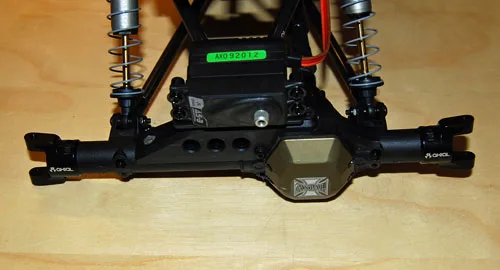
Manufacturer workshop image: front axle C-hub installation stage on an Axial crawler.
Specific Axial C-hub orientation and axle components; not a ride-height or droop measurement.
Axial Adventure; Bender's AX10 Ridgecrest Stage 3 (photographer not identified) · Manufacturer copyright; permission required before public release
Photo credit & source ↗View the teaching schematic
Goal
Ride height and droop are related but not interchangeable. Ride height is the vehicle’s resting position on its wheels under a defined setup. Droop is the available suspension extension measured by a defined method. Before measuring either, install the intended wheels and tires, body if the manual/setup-sheet method includes it, and the usual battery so its mass is represented. Keep the battery disconnected before placing hands near the drivetrain or suspension. Powered servo centering is a separate manual-guided task; switch power off before mechanical measurement.
Establish the loaded measuring condition
Use a flat, repeatable surface. Roll the vehicle forward and back gently to settle the suspension rather than pressing one corner and reading a temporary position. Measure at the manual’s stated reference point—often chassis, arm or another model-specific feature—not at a visually convenient bumper. Team Associated’s RC8B3.1 tuning guide describes a model-specific droop measurement between shock mounting references with the chassis elevated. Its RC10 Classic guide defines ride height from ground to chassis. These examples show why the method belongs beside the number; neither model’s settings are prescribed here.
Compare extension correctly
For droop, follow the exact chassis manual. Some platforms use droop screws, some use limiter hardware, and others need a setup board or a particular wheel/arm reference. Do not force an arm down to a borrowed measurement; that can hide binding or overextend a component. With the car supported as the manual describes, compare left and right extension and look for a shock that tops out differently, a bent hinge pin, a link binding or a tire contacting something.
A useful check table in your notebook has four columns: condition, ride-height reference, left/right observation, and change made. Example: “indoor hardpack; chassis reference; front even, rear left lower; no adjustment yet.” The next entry can say whether a documented preload or service change corrected it. This keeps a hypothetical test from becoming a claim that one height suits every track.
Stop and service before tuning if the chassis will not settle consistently, one corner hangs up, a shock leaks or binds, a tire rubs at full travel, or a suspension part is bent or cracked. A ride-height adjustment is not a repair for those faults. Once the vehicle is consistent, change one manual-compatible variable and repeat the same measurement conditions. The result you want is a comparable record that explains what changed, not a magic millimetre number.
Repeat check
Measure again after a normal run before adjusting anything. An unexpected corner change can point to tire seating, wheel hardware, shock mounting or suspension freedom. Where a manual specifies a board, use it instead of borrowing online ruler references. Keep power disconnected during every measurement. A consistent method makes a small change meaningful and a large discrepancy easier to investigate.
Check table
| Condition | Reference | Left/right | Action |
|---|---|---|---|
| Before run | Manual point | Even / note difference | None or service |
| After run | Same point | Compare | Investigate change first |
This table is a record format, not a target setting.
Leave with a useful record.
This is a reading aid, not a safety certification. Checks stay only on this page and reset when you reload.
Sources & scope
Primary references checked September 19, 2026. These dates describe source review, not publication of this site. Examples labelled hypothetical or illustrative are not tests.
Team Associated — RC8B3.1 tuning guide: droop
Supports: Droop limits suspension extension and uses defined model-specific reference points.
Limit: Only the droop section is used. Numerical settings and unfinished sections are not transferred to other vehicles.
Source publication: not established · Checked: 2026-09-19
Team Associated — RC10 Classic manual: tuning tips
Supports: Ride height is measured between ground and chassis using a specified procedure.
Limit: Method example only; model-specific target heights are not generalized.
Source publication: not established · Checked: 2026-09-19