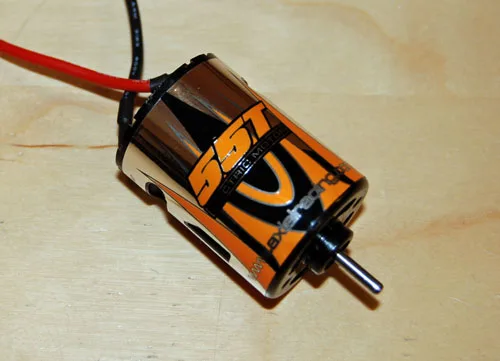
Manufacturer workshop image: 55-turn brushed motor selected for an Axial crawler build.
This is a specific brushed motor, not a transmission or a general performance comparison.
Axial Adventure; Bender's AX10 Ridgecrest Stage 3 (photographer not identified) · Manufacturer copyright; permission required before public release
Photo credit & source ↗From the September 2026 research edition. Product details and prices are dated source records; confirm the exact model and manual before buying or making changes.
Almost every RC car listing leads with the motor: "brushed," "brushless," "sensored," "3200 Kv." These words make a real difference to how fast the car goes, how much it costs and how much upkeep it needs. The labels don't tell you which one suits the way you plan to drive, though.
This guide explains how each motor type works in plain terms. It compares efficiency, maintenance and cost using what manufacturers and long-running RC publications say, and covers where each type still makes sense. It also looks at what an upgrade from brushed to brushless involves.
Quick answer
- Brushless motors run with less friction and need less maintenance. Horizon Hobby says they are "10-15% more energy efficient" than brushed motors.
- Brushed motors cost less and are simple. They still make sense for tight budgets, gentle first cars and some water-heavy crawling.
- For crawlers, Big Squid RC notes the real choice is brushed vs. sensored brushless, because sensorless brushless motors "cog" at low speed.
- Many brushed RTRs can be upgraded. Traxxas's own Slash conversion swaps in a VXL-3s speed control and Velineon 3500 motor, re-gears, and claims speed goes from "30+mph" to "60+mph."
- Whatever you choose, match the motor and speed control to the battery voltage the vehicle is rated for.
How brushed motors work
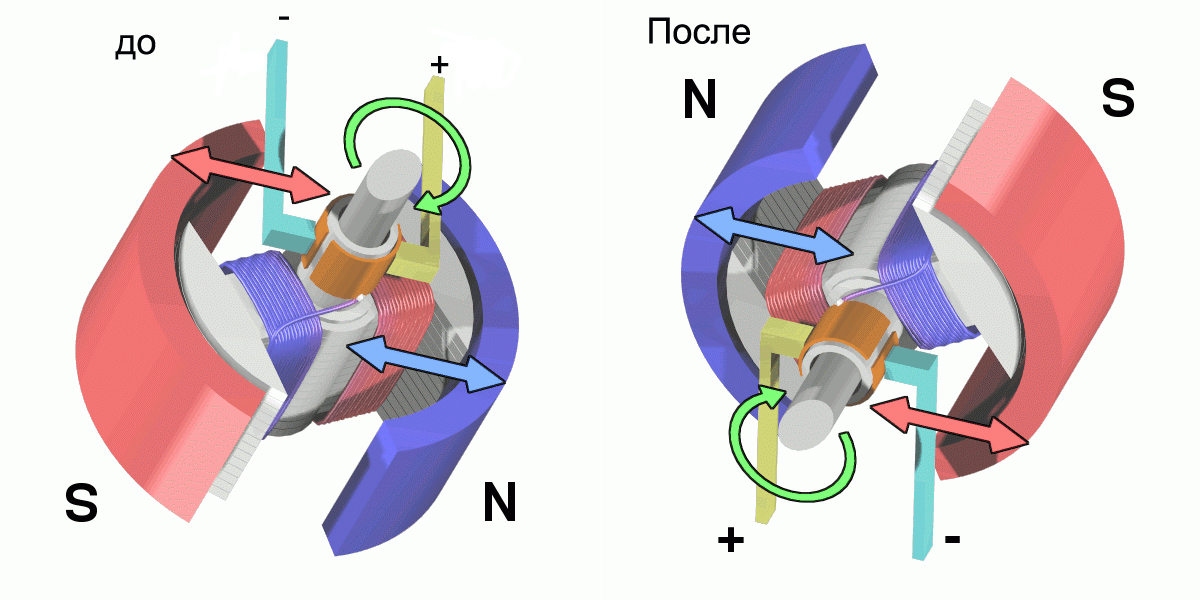
A brushed motor spins because small carbon brushes press against a rotating part called the commutator. The commutator switches the direction of current through the spinning windings as the motor turns. In RC Car Action's words, brushed motors "rely on physical contact (the brushes touching the commutator) to conduct electricity to the motor."
That rubbing contact is both the strength and the weakness of the design. It is simple and cheap to build, and a basic speed control can drive it. But the brushes wear, the contact creates friction and heat, and performance fades as parts wear.
Current examples of brushed RTRs, at list prices as of September 17, 2026:
- Traxxas Slash 2WD XL-5 with battery: Titan 12T 550 brushed motor. Claimed "30+ mph with 7-cell battery." $259.95, with a NiMH battery and USB-C charger included.
- ARRMA Gorgon 2WD brushed with battery and charger: Mega 550 14T brushed motor. Claimed "20+ MPH." $189.99.
- Losi Mini LMT 2S 4X4: a 1/18 brushed monster truck. Claimed "20+ mph." $249.99 with battery and charger.
How brushless motors work
A brushless motor turns the design inside out. RC Car Action explains that brushless motors "house the motor's windings in a stationary stator that then pulls on the magnetized rotor, eliminating the physical contact of the brushes."
Because there are no brushes, the electronic speed control (ESC) has to do the commutator's job. It switches current through the windings in the right order, and to do that it needs to know where the rotor is. There are two ways to find out:
- Sensored: small Hall-effect sensors in the motor report rotor position through a sensor cable.
- Sensorless: the ESC works out rotor position from the motor's electrical feedback. Castle Creations describes this as using "back EMF" for rotor position detection.
Examples at list price as of September 17, 2026: the new Traxxas Slash 4X4 Brushless ($429.95) uses a Velineon V3200 3200 Kv sensorless brushless motor, and the ARRMA Granite 223S ($339.99) uses a Spektrum 3100 Kv motor.
What "Kv" means
Kv is roughly how many RPM the motor turns per volt with no load. Castle Creations gives the example that "a 2S battery is 7.4 volts which means at full throttle, a 4600Kv motor would turn 34,040 RPMs." Real RPM under load is lower. Our top-speed article covers why.
A higher Kv number doesn't make a motor "better." It means more RPM per volt, which must be matched to the battery voltage and gearing. Hobbywing's MAX10 G2 manual shows this in practice: it pairs its 140A ESC with motors of "KV≤ 4000" on 3S and "KV≤ 2600" on 4S.
What "turns" means
You'll also see motors labeled by turns, such as "17.5T." RC Car Action explains that this "refers to the number of times the wire inside the motor is wrapped around the stator." Castle notes the term originally described windings in brushed motors. RCexplained, a tutorial site, adds that higher turn counts mean lower Kv, but "Kv is a more precise specification for predicting RPM than turn count alone." Turn ratings matter most in racing, where many classes specify the motor.
Side-by-side comparison
| Brushed | Brushless | |
|---|---|---|
| How it switches current | Brushes rubbing on a commutator | The ESC switches current electronically |
| Efficiency | Friction "reduces performance" (Horizon Hobby) | "10-15% more energy efficient" (Horizon Hobby) |
| Maintenance | Brushes and commutator wear | "Significantly less maintenance" (RC Car Action) |
| Cost | Lower | Higher ("more expensive," Horizon Hobby) |
| Low-speed smoothness | Smooth | Sensored: smooth. Sensorless: can "cog" from a stop (Castle) |
| Water | Big Squid RC: "operate just fine in the drink" (crawler context) | Sensored systems "DO NOT like water or mud" (Big Squid RC) |
| Typical use | Entry-level RTRs, some crawlers | Most bashers, speed runs and racing |
Sensored vs. sensorless brushless
This choice matters as much as brushed vs. brushless.
Sensored motors start smoothly. Castle Creations says sensors let the ESC "start the motor at very low RPMs with no 'cogging'." RC Car Action adds that they are "generally more responsive at low rpm and provide more initial torque." The drawback, according to Castle, "shows up at higher speeds when the sensor feedback becomes unreliable" in harsh, dusty or hot conditions.
Sensorless motors are simpler and tough, and Castle says their "performance at high speed is excellent." The catch is low-speed behavior: they "will, by nature, 'cog' or stutter when attempting to apply the throttle slowly from a complete stop." Many basher trucks use sensorless motors, including the Traxxas Velineon V3200 in the 2026 Slash and Stampede.
Some systems try to offer both. Castle's SmartSense uses the sensors for "smooth starts, excellent torque, and low-speed drivability," then switches to sensorless running. Tekin's Dual Mode "uses the motor sensors for the first few thousand RPM which then transitions to Sensorless operation." Tekin also notes that its timing boost and turbo features need Sensored Only mode.
Which should you buy?
Choose brushed if...
- Budget comes first. The ARRMA Gorgon brushed bundle lists at $189.99 with battery and charger.
- The driver is young or brand new. A "20+ MPH" car is easier to learn on than a 50+ mph claim.
- You crawl in water a lot. Big Squid RC's crawler column noted that brushed motors handle water well and that replacements were cheap. It quoted "$15-$25 bucks," but those are 2014 prices, so treat them as history rather than a current quote.
Choose brushless if...
- You want speed and punch. Traxxas's new Slash 4X4 and Stampede 4X4 Brushless claim 50+ mph on 3S LiPo, and ARRMA's 1/10 223S trucks carry "50+ mph" or "50+ mph speed potential" claims. Those are manufacturer claims, and real results depend on conditions.
- You'd rather not maintain brushes. RC Car Action says brushless motors "require significantly less maintenance."
- You plan to race. Racing ESCs such as the Hobbywing XR10 Pro G3 are built for brushless motors (rated for 3.5T to 10.5T motors in modified classes).
For crawlers: brushed or sensored brushless
Big Squid RC rules out sensorless brushless for crawling because of cogging, which leaves "brushed vs. sensored brushless." Sensored gives smoother low-speed control, but keep the sensor wire and plugs away from water and mud.
Upgrading from brushed to brushless
Many hobby-grade brushed cars can be converted. Traxxas describes its Slash upgrade path in plain terms: "Simply remove the XL-5 speed control and Titan 550, and replace them with the VXL-3s and 3500 motor." The stock 16T pinion / 90T spur gearing changes to 23T/86T, and Traxxas says speed rises from "30+mph" to "60+mph." The Traxxas VXL-3s ESC lists at $109.95 as of September 17, 2026.
Before you convert any car, keep these points in mind:
- Battery matters. The VXL-3s defaults to LiPo mode. Traxxas says "LiPo power unlocks all the speed potential of the Velineon brushless system."
- Re-gear, don't guess. Hobbywing warns that stock gearing is not automatically right for upgraded electronics. Castle says to "Always start with the smallest pinion and largest spur available for your application."
- Check temperatures. Castle says to check motor temperature often "on the first run after changing the gearing, motor or increasing battery voltage."
- Respect voltage limits. Horizon Hobby notes that "each RC car's power system has a defined voltage limit."
- Watch the drivetrain. Traxxas's Slash upgrade article doesn't list driveshaft or differential upgrades as required. More power still means more stress, so inspect gears and driveshafts after your first runs.
Common mistakes
- Buying a sensorless system for a crawler. Expect cogging at crawling speeds.
- Choosing Kv without thinking about voltage. High Kv on a high cell count can overload the system. Follow the ESC maker's Kv-per-cell guidance.
- Keeping brushed-motor gearing after an upgrade. Hobbywing says overloading is "the most common reason for your ESC / Motor damage."
- Running a sensored setup through water. Big Squid RC's warning applies, and Castle lists "water submersion" among the causes that make a repair non-warranty.
- Free-revving a motor with no load. Castle's motor guide says "Any damage sustained from free revving is not covered."
FAQ
Is brushless always faster than brushed?
Usually, in like-for-like vehicles, but speed also depends on Kv, voltage and gearing. Traxxas says its brushed Titan 12-turn models are "Already capable of 35+ mph" and "will still benefit dramatically from the addition of a brushless system." (Its current Slash 2WD XL-5 page claims "30+ mph with 7-cell battery," so figures vary by model and battery.)
Are brushless motors waterproof?
The motor type alone doesn't make a car waterproof. Check the ESC and receiver ratings. Big Squid RC warns that sensored systems in particular "DO NOT like water or mud."
How much more efficient is brushless?
Horizon Hobby puts it at "10-15% more energy efficient." We didn't find independent test data to confirm that figure.
Can I put a brushless motor in any brushed RC car?
Hobby-grade cars with standard motor mounts are often convertible, as Traxxas's Slash upgrade shows. You'll need a brushless ESC, a suitable battery and new gearing. Check with the manufacturer for your model.
What does "sensored" mean on a brushless motor?
It has position sensors that tell the ESC where the rotor is. That gives smoother starts, which matters most for crawling and racing.
Sources
- RC Car Action "Crash Course" motor tech (PDF)
- Castle Creations: Motors, sensored vs. sensorless
- Castle Creations: Motor tech
- Castle Creations: Castle technology
- Castle Creations: Expert tips for your Castle motor
- Castle Creations Motor User Guide V4 (PDF)
- Castle Creations warranty and service
- Horizon Hobby: How fast can fast RC cars go?
- Big Squid RC: Brushed vs. brushless (crawlers)
- RCexplained: Brushless motor basics
- Tekin FAQ
- Hobbywing MAX10 G2 manual (PDF)
- HobbywingDirect: XR10 Pro G3
- HobbywingDirect: Overloading your gears
- Traxxas: Make a RC car go faster
- Traxxas: Slash 3-stage upgrade
- Traxxas VXL-3s ESC
- Traxxas Slash 2WD XL-5 with battery
- Traxxas Slash 4X4 Brushless
- Horizon Hobby: ARRMA Gorgon brushed with battery and charger
- Horizon Hobby: ARRMA Granite 223S
- Losi LMT platform