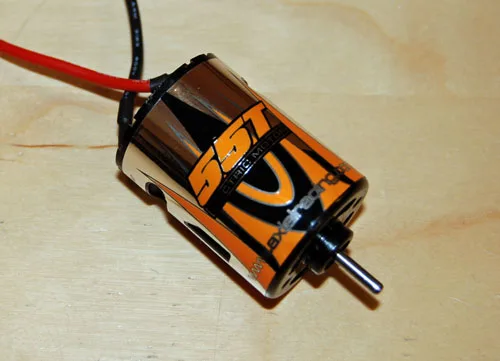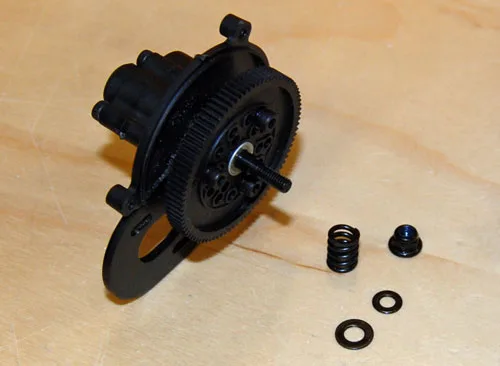
Manufacturer workshop image: Axial slipper-clutch/spur-gear assembly before removal.
Specific Axial slipper-clutch assembly; spring, washers and service order are model-specific.
Axial Adventure; Bender's AX10 Ridgecrest Stage 3 (photographer not identified) · Manufacturer copyright; permission required before public release
Photo credit & source ↗From the September 2026 research edition. Product details and prices are dated source records; confirm the exact model and manual before buying or making changes.
Gearing is the cheapest tuning change you can make to an electric RC car. A pinion gear costs far less than a new motor, and swapping it can change top speed, acceleration, run time and motor temperature. Get it wrong, though, and it is also one of the fastest ways to overheat a motor or speed control.
The good news is that the math is simple, and manufacturers publish clear rules for checking your work. This guide explains the parts involved and walks through the formulas for gear ratio, final drive ratio (FDR) and rollout with worked examples. It finishes with the mesh and temperature checks manufacturers recommend after any gearing change.
Key takeaways
- Gear ratio = spur teeth ÷ pinion teeth. FDR = transmission ratio × gear ratio. (Team Associated)
- A bigger pinion or smaller spur means more theoretical top speed and more motor load. A smaller pinion or bigger spur means the opposite. (Castle Creations, Traxxas)
- Rollout = tire circumference ÷ FDR tells you how far the car moves per motor revolution.
- After any change, set the gear mesh with a strip of paper and check motor temperature after a short run.
- Castle's advice for new setups: "Always start with the smallest pinion and largest spur available for your application."
The parts: pinion, spur, and transmission
- Pinion gear: the small gear on the motor shaft.
- Spur gear: the larger gear the pinion drives. On most cars it feeds the transmission or center differential.
- Transmission (internal) ratio: extra gear reduction inside the transmission, fixed by the car's design. Your manual or the manufacturer lists it.
- Final drive ratio (FDR): the total reduction between motor and wheels. The motor turns this many times for each turn of the wheels.
Pinion and spur must share the same tooth size (pitch or module). Mixing sizes will strip gears, so check your manual before buying.
The formulas
Gear ratio
Gear ratio = spur teeth ÷ pinion teeth
Team Associated's example: a 90-tooth spur with an 18-tooth pinion gives "90 divided by 18 = 5," or 5:1.
Final drive ratio
FDR = transmission ratio × (spur ÷ pinion)
Team Associated's example is a transmission with a 20-tooth input gear driving a 50-tooth gear. That gives an internal ratio of 50 ÷ 20 = 2.5. Combined with the 5:1 spur/pinion ratio above, FDR = 2.5 × 5 = 12.5:1. So Dialed and HobbywingDirect describe the same method.
Choosing a pinion for a target FDR
Rearranged, from So Dialed: Pinion = (transmission ratio × spur) ÷ target FDR
Rollout
Rollout = tire circumference ÷ FDR
Team Associated's example: a 90 mm tire has a circumference of 282.6 mm. Divided by an FDR of 12.5, that is 22.6 mm of travel per motor revolution. Rollout lets you compare setups on cars with different tire sizes, because it combines gearing and tire diameter into one number.
A worked example: gearing a Traxxas Slash for brushless
Traxxas's Slash upgrade article is a useful real example. Converting the truck from the brushed XL-5 and Titan 550 to the brushless VXL-3s and Velineon 3500, Traxxas changes the gearing from a 16T pinion / 90T spur to 23T / 86T.
Assumptions for this example:
- Transmission ratio of 2.72:1. Traxxas doesn't state this in the article. We back-calculated it from Traxxas's Drag Slash figures ("22-tooth pinion gear and a 76-tooth spur gear for a total gear reduction of 9.38:1") and assume the same transmission here.
- 110 mm tire diameter. Assumed as a typical 1/10 short-course tire, not a Traxxas figure.
| Setup | Spur ÷ pinion | FDR (× 2.72) | Rollout (345.6 mm tire circumference ÷ FDR) |
|---|---|---|---|
| Stock brushed: 16T / 90T | 5.625 | 15.30:1 | 22.6 mm |
| Hypothetical: 19T / 86T | 4.526 | 12.31:1 | 28.1 mm |
| Hypothetical: 20T / 86T | 4.300 | 11.70:1 | 29.5 mm |
| Traxxas brushless upgrade: 23T / 86T | 3.739 | 10.17:1 | 34.0 mm |
What this shows:
- The brushless gearing is much "taller." At the same motor RPM, 34.0 mm of rollout vs. 22.6 mm is about 50% more theoretical ground speed. Per Castle and Traxxas, taller gearing like this also means more motor load and heat.
- Picking a pinion for a target FDR. Say you wanted about 12:1 with the 86T spur. Pinion = (2.72 × 86) ÷ 12 = 19.5. You'd choose a 19T (12.31:1, slightly milder) or a 20T (11.70:1, slightly taller). When in doubt, pick the milder option first and check temperatures.
The two middle rows are illustrations of the math only. They aren't Traxxas recommendations, so check your manual for the pinion range your car and motor support.
To turn FDR into a theoretical top speed, see our top-speed article. It uses this same Slash setup and explains why the real-world number differs.
Which direction to change
Manufacturers put it plainly:
- Castle Creations: "Gear down = more gear reduction, less motor load, theoretically less top speed." "Gear up = less gear reduction, more motor load, theoretically more top speed."
- Traxxas: "A larger pinion gear or a smaller spur gear will both provide more speed," but this "makes the [motor] work harder and heat up faster. High speed gearing should only be used for hard flat surfaces like pavement."
| Change | Gear ratio / FDR | Theoretical top speed | Motor load and heat |
|---|---|---|---|
| Bigger pinion | Lower (taller) | Higher | Higher |
| Smaller pinion | Higher (shorter) | Lower | Lower |
| Bigger spur | Higher (shorter) | Lower | Lower |
| Smaller spur | Lower (taller) | Higher | Higher |
Castle uses the word "theoretically" for a reason. If a car is geared too tall for its motor, battery, surface or tires, it may not reach the higher speed at all. It may just run hotter.
Gearing also has to suit the motor and voltage. Hobbywing, for example, pairs its EZRun MAX10 G2 140A speed control with motors of "KV≤ 4000" on 3S and "KV≤ 2600" on 4S. Higher voltage or higher Kv generally calls for more conservative gearing.
Setting gear mesh
Gear mesh is how tightly the pinion's teeth engage the spur's. Too tight adds drag and heat. Too loose risks stripped teeth.
The manufacturers describe the same paper method:
- Loosen the motor mount screws so the motor can slide.
- Traxxas: "Set the gear mesh by running a narrow strip of notebook paper between the pinion and spur gears."
- Push the gears together on the paper and tighten the motor screws.
- Spektrum: "remove the small piece of paper by rotating the spur gear."
- Check that the gears turn freely with a tiny amount of play, and recheck at a few points around the spur.
Recheck mesh whenever you change a pinion or spur, or after a hard crash.
The temperature check: how you know gearing is right
Gearing is only right if the motor and speed control stay within the manufacturer's temperature limits. Here's the routine manufacturers describe:
- Spektrum (Firma 2-in-1 manual): measure at the motor end bell after about 5-minute runs. If the temperature exceeds 160 °F (71 °C), reduce the gearing.
- Hobbywing: if it's too hot, change to "a smaller pinion or bigger spur gear by one," then "Check the temp again after running a few laps."
- Castle Creations: "Always check your motor temperature frequently on the first run after changing the gearing, motor or increasing battery voltage." If the motor approaches 180°, "reduce the pinion size, increase the spur size, or reduce the battery pack voltage."
- Tekin: "if your motor is coming off at 180*F after 5 minutes, don't go run a 15 minute practice session as you will likely overheat."
Temperature limits vary by manufacturer: Spektrum says 160 °F for its small 2-in-1, Castle and Tekin 180 °F, Traxxas 200 °F, and Hobbywing 90–100 °C. Use the figure for the motor you own. Our temperatures article lists each one with its source.
Common mistakes
- Gearing up and skipping the temperature check. Hobbywing calls overloading "the most common reason for your ESC / Motor damage."
- Keeping stock gearing after an electronics upgrade. Hobbywing warns that stock gearing isn't automatically right for new electronics.
- Using high-speed gearing on grass or dirt. Traxxas says high-speed gearing is for "hard flat surfaces like pavement."
- Setting the mesh too tight. Always use the paper method and check the gears turn freely.
- Mixing gear pitches. Pinion and spur must match.
- Changing several things at once. Change one variable, such as a pinion size or the battery, then run and check temperatures.
FAQ
Does a bigger pinion make my RC car faster?
Theoretically, yes. Traxxas and Castle both say a larger pinion gives more top speed. It also increases motor load and heat, so check temperatures, and it may not help on loose surfaces.
What's a good final drive ratio?
It depends on the car, motor Kv, battery voltage, tires and surface. Start from your manual's recommended gearing. Castle advises starting with "the smallest pinion and largest spur available for your application" and working up while checking temperatures.
How do I calculate final drive ratio if I don't know the transmission ratio?
Check the manual or the manufacturer's site. Some list total reduction directly: Traxxas gives 9.38:1 for the Drag Slash's 22T/76T gearing. Without the internal ratio, you can compare spur ÷ pinion ratios on the same car, but not across different cars.
How often should I check motor temperature after changing gears?
On the first run after the change, and after short runs. Spektrum and Tekin both use roughly 5-minute runs as the check point.
What happens if gear mesh is too tight or too loose?
Too tight adds friction and heat. Too loose can strip the spur. The paper-strip method from Traxxas and Spektrum gives a small, consistent gap.
Sources
- Team Associated: Gear ratios (PDF)
- So Dialed: Final drive ratio
- HobbywingDirect: R/C 101 pinion gears and FDR
- HobbywingDirect: Overloading your gears
- Hobbywing MAX10 G2 manual (PDF)
- HobbywingDirect FAQ
- Traxxas: Drag Slash tuning guide part 2
- Traxxas: Slash 3-stage upgrade
- Traxxas: Make a RC car go faster
- Traxxas Velineon 3500 motor installation instructions (PDF)
- Castle Creations: Expert tips for your Castle motor
- Castle Creations Motor User Guide V4 (PDF)
- Spektrum SPMXSEM0500 manual (PDF)
- Tekin FAQ