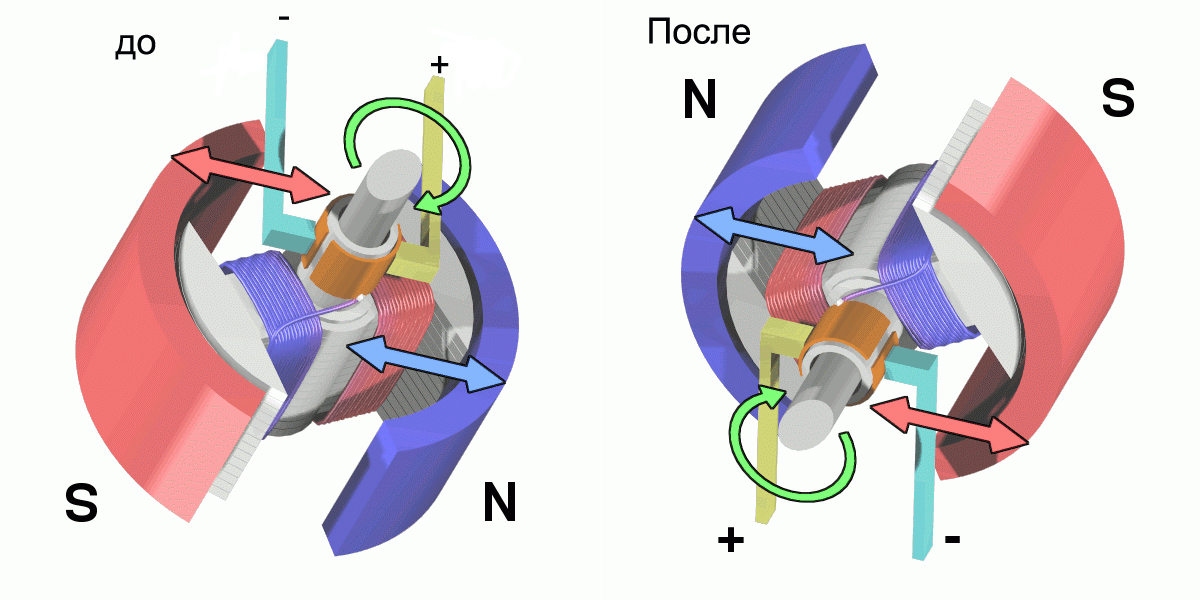
Electric motor principles, illustrated by G.N.C. This is a diagram, not a product photograph.
G.N.C. · CC BY-SA 3.0
Photo credit & source ↗From the September 2026 research edition. Product details and prices are dated source records; confirm the exact model and manual before buying or making changes.
"How hot should my motor get?" is one of the most common questions in RC, and the answers you'll find online are all over the place. Some say 140 °F, some say 200 °F, and plenty of people just touch the motor and guess.
The best answer is the one printed by the company that made your motor or speed control. This article collects the exact figures that Castle Creations, Tekin, Traxxas, Hobbywing and Spektrum publish, with the wording and source for each. It explains why the numbers differ, how to measure temperature consistently, and what manufacturers say to do when things run hot.
Quick answer
- Published motor limits range from 160 °F (71 °C) for Spektrum's Firma 2-in-1 system to 212 °F (100 °C) at the top of Hobbywing's range.
- Castle and Tekin: 180 °F. Traxxas: 200 °F. Hobbywing: 90–100 °C (194–212 °F).
- For ESCs, Hobbywing's FAQ says its ESCs are designed to perform up to 70 °C (158 °F), with 80 °C (176 °F) the highest.
- Use the number from the maker of your motor and ESC, and measure the same way every time.
- Too hot? Manufacturers say to gear down (smaller pinion or bigger spur), reduce voltage, or shorten runs.
The manufacturer figures
All sources below were accessed September 17, 2026.
Motor temperature limits
| Manufacturer | Limit | Exact wording | Where it's published |
|---|---|---|---|
| Spektrum (Firma 2-in-1, SPMXSEM0500) | 160 °F (71 °C), whole system | "Your system's operating temperature should never exceed 160° F (71° C)." | Product manual. Measure at the motor end bell after about 5-minute runs |
| Castle Creations | 180 °F (about 82 °C) | "Never let the motor get above 180°F." | Motor User Guide V4 |
| Castle Creations | About 180° | "If the motor starts to get close to 180° reduce the pinion size, increase the spur size, or reduce the battery pack voltage." | Castle blog, June 13, 2023 |
| Tekin | 180 °F | "keep ANY Tekin motor, be it 1/10 or 1/8, under 180*F at all times" | Tekin FAQ |
| Traxxas | 200 °F (93 °C) | "Generally, try to keep your motor below 200° F." | Velineon 3500 motor instructions |
| Traxxas | 200 °F (93 °C) | "make certain it does not exceed 200° F (93° C)" | Drag Slash tuning guide, part 2 |
| Hobbywing | 90–100 °C (194–212 °F) | "For HOBBYWING brushless Motor, 90-100℃ (194-212F) is within threshold. Any higher temp will damage the motor." | HobbywingDirect FAQ |
| Hobbywing | 90 °C with a cheap IR thermometer; 100 °C with an accurate one | "…or the motor temperature is over 90 degree or 100 degree, your system configuration must be changed immediately" | HobbywingDirect support article and blog |
ESC temperature guidance
| Manufacturer | Figure | Notes |
|---|---|---|
| Hobbywing (FAQ) | Designed for up to 70 °C (158 °F), "the highest at 80 ℃" (176 °F) | "…our ESC is designed for the performance at temperature range upto 70, the highest at 80 ℃" |
| Hobbywing (support article and blog) | 85 °C / 90 °C (185 °F / 194 °F) | Given alongside the motor figures above, as the point where configuration should change |
| Spektrum (Firma 2-in-1) | 160 °F (71 °C) | Applies to the whole motor/ESC system |
| Traxxas (VXL-3s, VXL-6s) | No number found | The VXL-3s lists thermal shutdown protection, and the VXL-6s lists two-stage thermal protection |
Hobbywing's ESC numbers differ between its FAQ (70 °C design, 80 °C highest) and its support article (85 °C / 90 °C). We found no explanation for the difference. The lower FAQ figures are the more conservative choice.
A "failure" figure is not a target
Castle's technology page describes motors running "near their failure temperature (300ᵒF/150ᵒC)." That is where damage happens, not a safe operating limit. Castle's own guide still says never let the motor get above 180 °F. (A side note: 150 °C is actually about 302 °F.)
Why the numbers differ
Five manufacturers, four different ceilings. There are a few reasons, some of which the sources state directly.
1. They describe different products
Spektrum's 160 °F figure comes from the manual for a small Firma 2-in-1 system, and it covers the whole motor/ESC unit rather than a standalone motor. Tekin's 180 °F covers "ANY Tekin motor, be it 1/10 or 1/8." Traxxas's 200 °F comes from its Velineon 3500 motor instructions and a Drag Slash guide. Motors differ in size, construction and materials, so limits naturally differ too.
2. Measuring tools differ
Hobbywing says so directly: its support guidance uses 90 °C if you measure with a cheap IR thermometer and 100 °C with an accurate one. An inexpensive infrared "temp gun" can read differently from a probe or built-in sensor, so a brand may build in margin for that.
3. Where and when you measure changes the reading
Spektrum specifies the motor end bell after about 5-minute runs. Tekin uses a similar five-minute check point. Heat keeps building during a run, so a reading taken after 5 minutes means something different from one taken after 15. Tekin says: "if your motor is coming off at 180*F after 5 minutes, don't go run a 15 minute practice session as you will likely overheat."
4. Safety margin and philosophy
Some limits are clearly conservative "stay under" numbers, like Tekin's "under 180*F at all times." Others describe a threshold. Hobbywing says 90–100 °C "is within threshold" and "any higher temp will damage the motor." Those are different kinds of statements, even when the numbers look close.
A note on non-manufacturer figures
RCexplained, a tutorial site, suggests motors run "usually up to 60°C (140°F)" and that "Exceeding 70°C (160°F) risks demagnetizing magnets." That is more conservative than any manufacturer figure here, and it isn't a manufacturer specification. (Its conversion is also slightly off: 70 °C is about 158 °F.) Where it conflicts with your motor's manual, follow the manual.
How to check temperature consistently
- Use the same tool every time. An IR thermometer is fine for tracking trends. Remember Hobbywing's point that cheap ones can be less accurate.
- Measure in the same place. Spektrum specifies the motor end bell.
- Measure at the same point in a run. Around 5 minutes matches the Spektrum and Tekin guidance.
- Check the ESC as well as the motor, especially after raising voltage or changing gearing.
- Use built-in logging if you have it. Castle's Mamba X logs data including temperature through Castle Link software (the Copperhead 10 lists a lighter "Data Logging Lite"), Spektrum Smart ESCs send temperature telemetry to compatible transmitters, and Hobbywing's MAX6 G2 and MAX8 G2S log data through the HW Link app.
- Set a motor temperature cutoff if your ESC supports one. Castle says its motor temperature cutoff can be set from "120F to 210F."
Always let the motor and ESC cool before touching them or making changes.
What to do when it runs hot
Manufacturers give consistent advice:
- Gear down. Castle: "reduce the pinion size, increase the spur size, or reduce the battery pack voltage." Hobbywing: change to "a smaller pinion or bigger spur gear by one," then "Check the temp again after running a few laps." Spektrum: reduce gearing if temperatures exceed 160 °F.
- Reduce voltage. Castle lists lower pack voltage as an option.
- Shorten runs. See Tekin's 5-minute vs. 15-minute warning above.
- Back off timing, boost and turbo. So Dialed, a tutorial site, advises: "When using turbo and boost, pay close attention to how hot the ESC and motor are getting." HobbywingDirect says a larger timing-punch value applies boost later, "which makes the application smoother, and generates less heat."
- Go easy on drag brake. Spektrum: "Drag brakes will consume more power and heat will be increased, start with small values."
- Recheck gear mesh. A mesh that's too tight adds drag. Set it with the paper method.
Castle also says to "Always check your motor temperature frequently on the first run after changing the gearing, motor or increasing battery voltage."
What to watch out for
- Using someone else's number. A 200 °F reading may be within Traxxas's guidance but well over Spektrum's 160 °F figure for its Firma 2-in-1.
- Ignoring the battery. Horizon Hobby's lithium battery safety sheet says to keep packs below 160 °F while discharging, and not to charge a pack that is hot to the touch (above 100 °F). Let packs cool before charging.
- Treating thermal shutdown as a tuning tool. Traxxas ESCs have thermal protection, but hitting it repeatedly means the setup is overloaded. Hobbywing calls overloading "the most common reason for your ESC / Motor damage."
- Free-revving to "test" a motor. Castle's motor guide says "Any damage sustained from free revving is not covered."
FAQ
What temperature should a brushless RC motor run at?
Follow the manufacturer: under 180 °F for Castle and Tekin, below 200 °F for Traxxas, 90–100 °C (194–212 °F) for Hobbywing, and under 160 °F for Spektrum's Firma 2-in-1 system.
Is 150 °F too hot for an RC motor?
By every manufacturer figure in this article, 150 °F is below the published limit. Check your own motor's manual to be sure.
How hot can an RC ESC get?
Hobbywing's FAQ says its ESCs are designed to perform up to 70 °C (158 °F), with 80 °C (176 °F) the highest. Apart from Spektrum's whole-system 160 °F figure for its Firma 2-in-1, the other brands we checked didn't publish an ESC number we could find. Traxxas's VXL ESCs list thermal protection instead.
Where should I point my temperature gun?
Spektrum specifies the motor end bell. Measure the same spot each time, after a similar run length.
Why does my motor get hot after I changed the pinion?
A bigger pinion increases load. Traxxas says it "makes the [motor] work harder and heat up faster." Drop back a tooth, as Hobbywing suggests, and recheck.
Sources
- Castle Creations Motor User Guide V4 (PDF)
- Castle Creations: Expert tips for your Castle motor
- Castle Creations: Castle technology
- Castle Creations Mamba X ESC
- Castle Creations Copperhead 10 ESC
- Tekin FAQ
- Traxxas Velineon 3500 motor installation instructions (PDF)
- Traxxas: Drag Slash tuning guide part 2
- Traxxas: Make a RC car go faster
- Traxxas VXL-3s ESC
- Traxxas VXL-6s ESC
- HobbywingDirect support article
- HobbywingDirect: Overloading your gears
- HobbywingDirect FAQ
- HobbywingDirect: What is boost timing
- HobbywingDirect: EZRun MAX6 G2
- HobbywingDirect: EZRun MAX8 G2S
- Spektrum SPMXSEM0500 manual (PDF)
- Spektrum Firma 160A Smart ESC V2
- So Dialed: Boost
- RCexplained: Brushless motor basics
- Horizon Hobby / Spektrum Lithium Battery Safety (PDF)