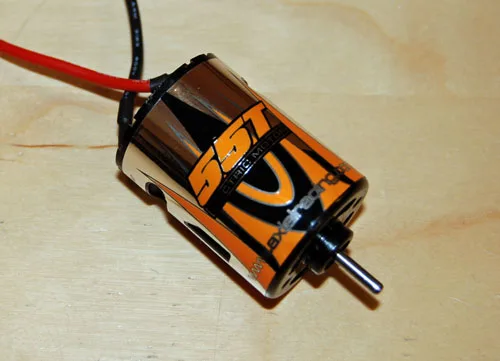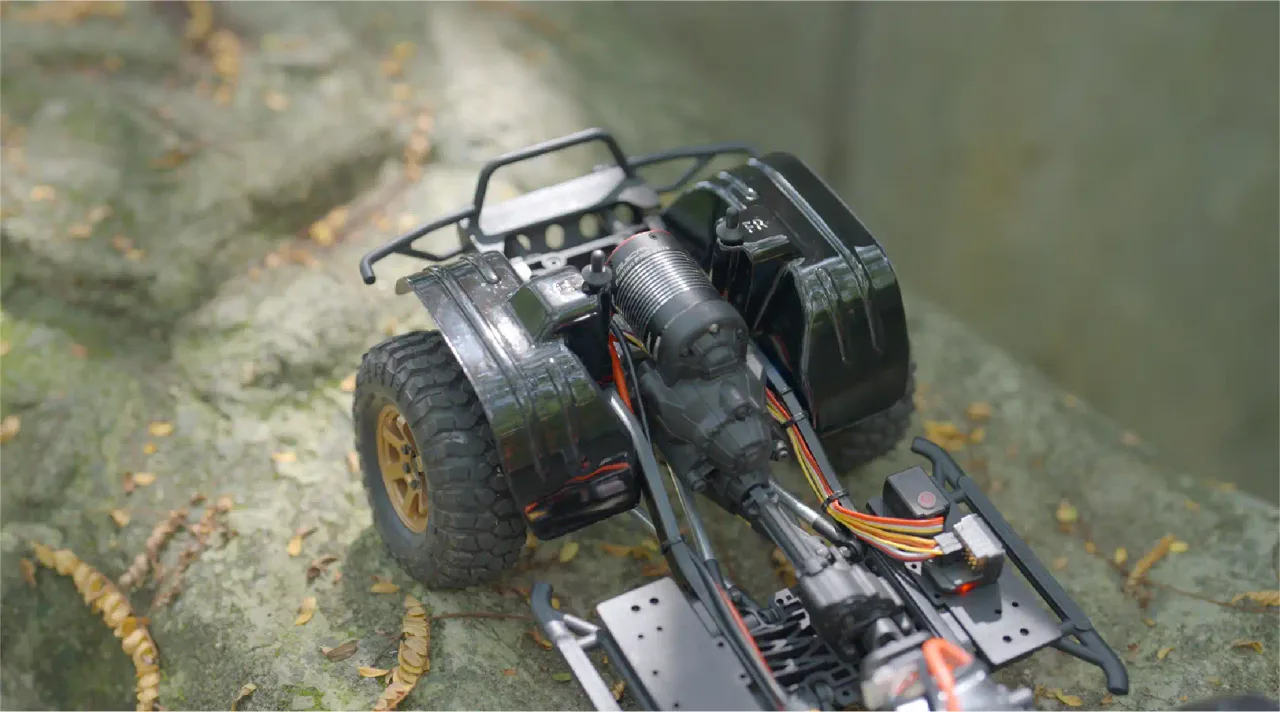
Manufacturer photograph showing an integrated motor/ESC installation. This pictured Fusion Pro Elite is an example, not proof that another model fits or performs the same way.
Hobbywing (photographer not identified) · Manufacturer copyright; permission required before public release
Photo credit & source ↗From the September 2026 research edition. Product details and prices are dated source records; confirm the exact model and manual before buying or making changes.
Crawling asks something unusual of a motor. Instead of top speed, you want the truck to creep up a rock at walking pace, stop exactly where you let off the throttle, and stay put on a steep face. That is harder than it sounds, and it is why crawler electronics have developed their own vocabulary.
One term you will see everywhere is FOC. Hobbywing uses it across its QuicRun Fusion 2-in-1 systems and its XeRun AXE R2 combo, and Redcat fits a Fusion unit to its Ascent Fusion crawler.
This article explains what FOC is (in plain terms), why low-speed smoothness and drag brake matter for crawling, and how the Fusion SE, Fusion Pro, Fusion Pro Elite and AXE R2 differ, using Hobbywing's own specifications.
Key takeaways
- Hobbywing defines FOC as "Field-oriented Control," which it says gives accurate motor control and sensing, better downhill control and very quiet running.
- Crawling needs smooth throttle at very low speed; sensorless brushless systems tend to "cog" (stutter) there, according to Castle Creations.
- The Fusion SE, Fusion Pro and Fusion Pro Elite are 2-in-1 units (motor and ESC in one); the AXE R2 is a separate ESC and sensored motor combo with a magnetic encoder.
- Voltage support differs: the Fusion SE, Fusion Pro and AXE R2 are listed for 2–3S, while the Fusion Pro Elite is listed for 2–4S.
- Amp ratings are not directly comparable across brands, so compare features and voltage support, not just the biggest number.
Why crawlers need special electronics
The low-speed problem
A brushless motor has no brushes; the ESC has to know where the rotor is to switch power at the right moment. Castle Creations explains that sensorless designs work out rotor position from "back EMF," and that sensorless motors "will, by nature, 'cog' or stutter when attempting to apply the throttle slowly from a complete stop."
Sensors fix much of that. Castle says sensored operation "allows for a smoother initial start" and lets the ESC "start the motor at very low RPMs with no 'cogging'." That is why Big Squid RC, writing about crawlers back in 2014, said sensorless brushless was effectively ruled out and the real choice was "brushed vs. sensored brushless."
Drag brake
Drag brake is braking applied automatically when the throttle is at neutral. Tekin describes it as providing "immediate braking action in neutral." For a crawler, strong drag brake stops the truck from rolling backward off a ledge or down a slope. Castle even offers a "Crawler Full On" setting that "applies full brake at neutral throttle to prevent crawler-type vehicles from rolling."
There is a trade-off. Spektrum warns: "Drag brakes will consume more power and heat will be increased, start with small values."
What is FOC?
In general terms, field-oriented control is a way of driving a brushless motor that controls the motor's magnetic field precisely, rather than switching it on and off in coarse steps. The goal is smoother torque, particularly at very low speeds.
Here is how Hobbywing describes it for its own products:
- On the XeRun AXE R2 page, Hobbywing defines FOC as "Field-oriented Control" and says it provides "extremely accurate control and sensing of the motor," better downhill control, and "extremely silent" running without PWM noise.
- On the Fusion Pro page, it describes a "patented FOC system" with a "sine wave driving mode" and says low-speed torque exceeds "common sensored brushless" systems.
- On the Fusion SE page, it calls its FOC sine-wave drive "far superior to the common sensored brushless power system" at very low speed.
Those comparisons are Hobbywing's marketing claims. We did not find independent measurements comparing FOC and conventional sensored systems in our research, so treat the "superior" language as the manufacturer's view.
The Hobbywing lineup compared
Prices are as shown by Hobbywing North America as of September 17, 2026, where listed. They change often.
| System | Type | Motor | Current (cont. / peak) | LiPo | BEC | Water rating | Price |
|---|---|---|---|---|---|---|---|
| QuicRun Fusion SE | 2-in-1 | 1200KV or 1800KV | 40A | 2–3S | Not listed in our source | IP67 | $79.99–$89.99 |
| QuicRun Fusion Pro | 2-in-1 | 2300KV 540 | 60A / 200A | 2–3S | 6A at 6/7.4V | IP67 | $139.99 sale ($215 MSRP) |
| QuicRun Fusion Pro Elite | 2-in-1 | 2300KV | 50A / 150A | 2–4S | 10A, selectable 6/7.4/8.4V | IP67 | Not captured |
| XeRun AXE R2 | ESC + sensored motor combo | 1400, 2100, 2300, 2800 or 3300KV | 80A / 480A | 2–3S | 6A at 6/7.4V | IP67 | Not captured |
| QuicRun Fusion 8IGHT | 2-in-1 | 4269SD 2300KV | Not listed in our source | Not listed in our source | 6A / 13A at 6/7.4/8.4V | IP67 | $169.99 (from $240) |
QuicRun Fusion SE
The Fusion SE is the entry point. Hobbywing lists 40A, a choice of 1200KV or 1800KV, 2–3S LiPo support, IP67, active drag brake and setup through an LED program box. At $79.99–$89.99 it is the least expensive of the Hobbywing FOC crawler systems covered here.
Good for: a first brushless upgrade on a 1/10 trail truck where you mainly want smoother low-speed control and hold on hills.
QuicRun Fusion Pro
The Fusion Pro steps up to a 2300KV 540-size motor with 60A continuous and 200A peak ratings, 2–3S support and a 6A BEC selectable at 6V or 7.4V. Hobbywing highlights "active drag brake force adjustment" for parking on slopes, plus cruise and slope-descent functions.
Good for: owners who want more adjustment and a stronger BEC for a bigger servo, while staying on 2–3S.
QuicRun Fusion Pro Elite
The Pro Elite is the one to look at if you run 4S. Hobbywing lists 2300KV, 50A continuous and 150A peak, 2–4S LiPo, a 10A BEC selectable at 6, 7.4 or 8.4V, five modes, 14 adjustable parameters, and an auxiliary channel for tuning on the trail. It is 48.5mm long, which Hobbywing says is 9.5mm shorter than the standard Fusion Pro, useful where chassis space is tight.
Note that its listed continuous current (50A) is lower than the Fusion Pro's (60A), even though it supports higher voltage and has a stronger BEC. Read the whole spec sheet rather than assuming "Elite" means bigger numbers everywhere.
Good for: 4S builds, and high-voltage servos that benefit from an 8.4V, 10A BEC.
XeRun AXE R2
The AXE R2 is not a 2-in-1. It is a sensored FOC ESC and motor combo that uses a "high precision magnetic encoder" in place of standard hall sensors. Hobbywing lists 80A continuous and 480A peak, 2–3S, a 6A BEC at 6/7.4V, IP67, Bluetooth app control, and rock-crawler and forward/reverse-with-brake modes. Its drag brake is adjustable in both rate and speed, which Hobbywing describes as "rated at 200%." Motors come in 1400, 2100, 2300, 2800 and 3300KV.
Good for: builders who want to choose a motor KV separately and tune from a phone.
Where the Fusion 8IGHT fits
Hobbywing also sells the QuicRun Fusion 8IGHT, a 2-in-1 FOC crawler system built around a 4269SD 2300KV motor, with a BEC selectable at 6/7.4/8.4V (listed as 6A / 13A), and IP67. It was $169.99 (from $240) on Hobbywing North America. We did not capture its voltage range, so check the product page.
FOC in a ready-to-run truck
You do not have to buy these separately. Redcat's Ascent Fusion LCG ($449.99, list price as of September 17, 2026) ships with a Hobbywing Fusion 540 1800KV integrated motor/ESC. At the larger end, Axial's 1/6 SCX6 uses a Spektrum Firma 1200Kv sensored brushless motor with a Firma Crawler 120A sensored Smart ESC, which is a sensored system rather than one Hobbywing markets as FOC.
Most sub-$550 1/10 RTRs we looked at still ship with brushed motors, including the Traxxas TRX-4 (Titan 21T 550), Redcat Gen9 (17T), Vanquish VS4-10 Phoenix Portal (35T) and Element Enduro Knightrunner (Reedy 16T).
How to choose
- Check your battery plan. If you want 4S, the Fusion Pro Elite is the only unit in this group listed for it. Never run more cells than a system is rated for.
- Match the BEC to your servo. A high-torque, high-voltage servo can draw more current than a small BEC supplies. Castle Creations says an external BEC "can help prevent brownouts" if your steering servo causes receiver resets.
- Think about fit. 2-in-1 units save space and wiring; the Pro Elite's shorter length may help in a tight chassis.
- Decide how much tuning you want. The SE uses an LED program box, the Pro Elite adds trail tuning through an aux channel, and the AXE R2 offers Bluetooth app control.
- Pick KV for your truck. Lower KV generally means lower RPM per volt. The Fusion SE's 1200KV option and the AXE R2's 1400KV motor sit at the low end of what Hobbywing offers here.
Common mistakes
- Comparing amp ratings across brands. Manufacturers rate current differently, so a bigger number on one brand's box does not necessarily mean a stronger system than another brand's.
- Maxing out drag brake without watching temperature. Spektrum warns drag brake adds power use and heat. Start low and increase gradually.
- Assuming "waterproof" means submersible. IP67 is a rating for specific test conditions. Dry and clean your truck after wet runs and follow the manufacturer's manual.
- Treating marketing comparisons as test results. "Far superior" is Hobbywing's description, not an independent measurement.
FAQ
What does FOC stand for?
Field-oriented control. Hobbywing writes it as "Field-oriented Control."
Is FOC the same as sensored brushless?
Not exactly. FOC describes how the motor is driven. Hobbywing's AXE R2 combines FOC with a magnetic encoder, while Hobbywing positions its Fusion 2-in-1 units as outperforming "common sensored brushless" systems at low speed.
Which Hobbywing Fusion supports 4S?
Of the units covered here, Hobbywing lists the Fusion Pro Elite for 2–4S. The Fusion SE and Fusion Pro are listed for 2–3S.
Is a brushed motor still fine for crawling?
Yes, many popular RTRs ship brushed. Big Squid RC noted in 2014 that brushed motors "operate just fine in the drink," while sensored systems "DO NOT like water or mud."
What is the cheapest FOC crawler system from Hobbywing?
Of those covered here, the Fusion SE at $79.99–$89.99 as of September 17, 2026.
Sources
- Hobbywing XeRun AXE R2 combo
- Hobbywing North America: QuicRun Fusion Pro
- Hobbywing North America: QuicRun Fusion SE
- Hobbywing: QuicRun Fusion Pro Elite
- Hobbywing North America: QuicRun Fusion 8IGHT
- Castle Creations: Sensored vs. sensorless motors
- Castle Creations: BECs and voltage regulators
- Big Squid RC: Brushed vs. brushless for scalers
- Tekin RSX manual
- Castle Creations Cobra 5 guide
- Spektrum Firma ESC manual
- Redcat Ascent Fusion LCG
- Axial SCX6 Jeep JLU Wrangler
- Traxxas TRX-4 Ford Bronco
- Redcat Gen9
- Vanquish VS4-10 Phoenix Portal RTR
- Element RC Enduro Knightrunner RTR