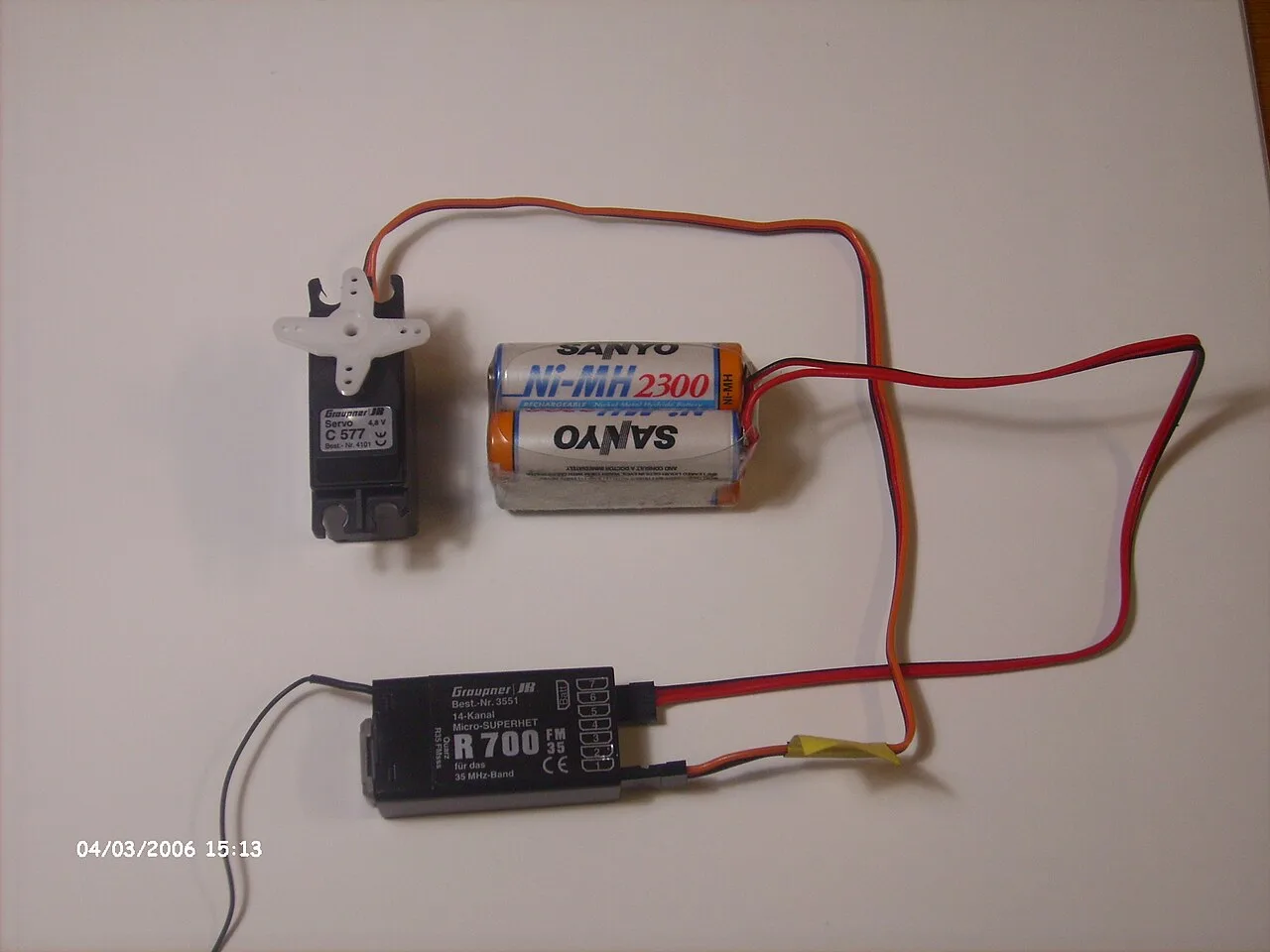
Historical RC-aircraft control components, including a 35 MHz receiver. This is not a current car-radio recommendation; connector appearance cannot establish compatibility.
Michael32710 · CC BY-SA 3.0
Photo credit & source ↗From the September 2026 research edition. Product details and prices are dated source records; confirm the exact model and manual before buying or making changes.
FPV (first-person view) turns an RC car into something closer to a real driving experience. A small camera and video transmitter on the car send live video to goggles or a screen, so you see what the car sees. Many RC drivers borrow this gear from the drone world, including popular digital systems from DJI and analog 5.8 GHz video transmitters.
That raises two U.S. regulatory questions: which FCC rules let you transmit video, and at what power? And how does the FCC's December 2025 decision to add foreign-made drones and drone components to its "Covered List" affect gear you might put on a car?
This article summarises the relevant FCC rules and orders as of September 17, 2026. It is general information, not legal advice. Rules and FCC decisions change, and for anything that matters to you, read the primary documents or consult a qualified attorney.
Key takeaways
- Most consumer FPV gear operates under FCC Part 15 (unlicensed) rules, which have strict limits. Analog video transmitters face very low power limits if they fall under §15.249.
- A ham radio license (Part 97) allows higher power on the 5 cm band, but bans encrypted messages and commercial use, and requires station ID.
- On December 22, 2025, the FCC added "all UAS and UAS critical components produced in a foreign country" to the Covered List. That blocks new FCC equipment authorizations; the FCC says it does not affect previously purchased drones.
- Later FCC actions in January, May and July 2026 added exemptions and extended firmware-update waivers to at least January 1, 2029.
- Open question: whether a video transmitter, camera or radio used on an RC car counts as a "UAS critical component" has not been clarified in any FCC document we retrieved.
Part 15: the unlicensed rules
Part 15 of the FCC's rules covers devices you can use without a license. Two sections matter for 5.8 GHz FPV.
§15.249: the low-power limit
In the 5725–5875 MHz band, §15.249 limits the fundamental signal to a field strength of 50 millivolts per metre, measured at 3 metres, with harmonics limited to 500 microvolts per metre. That is a very small amount of power. Flite Test (published June 11, 2016) converts it to "approximately 0.45 milliwatts ERP." A rough conversion of the same limit using EIRP = (E × d)² / 30 gives about 0.75 mW EIRP, which is consistent (EIRP and ERP are two ways of expressing radiated power that differ by a fixed amount).
Flite Test's warning is blunt: "Don't be fooled by manufacturers saying their gear puts out 25 mW and you don't need a license!" It also states: "If any intentional radiator is not FCC certified, you need a license to operate it."
§15.247: digital modulation
§15.247 allows digitally modulated systems in 5725–5850 MHz with a 6 dB bandwidth of at least 500 kHz to use up to "1 Watt" of conducted output power, with reductions when antenna gain exceeds 6 dBi. This is the kind of rule that allows FCC-certified digital systems to list much higher power. For example, DJI lists the O4 Air Unit Pro at under 33 dBm EIRP (FCC) at 5.8 GHz and the non-Pro O4 Air Unit at under 30 dBm (FCC).
What is less clear: analog FM video transmitters are commonly assumed not to qualify under §15.247 and therefore to fall back to the §15.249 limits. We did not find an FCC statement confirming this, so treat it as a widely held interpretation, not a settled fact.
Part 97: FPV with a ham radio license
Amateur (ham) radio licensees operate under Part 97, which opens up far more power but comes with its own rules.
- Band access: the 5 cm amateur band (5.650–5.925 GHz in ITU Region 2, which includes the U.S.) appears in the §97.301(a) table, the table that covers Technician, General, Advanced and Amateur Extra licensees. Check the current table on eCFR to confirm your license class's privileges.
- Power: "An amateur station must use the minimum transmitter power necessary," with an overall ceiling of 1.5 kW PEP. The ceiling is not a target; the minimum-power rule applies.
- No encryption: Part 97 prohibits "messages encoded for the purpose of obscuring their meaning." Encrypted digital FPV links therefore do not fit amateur operation.
- No commercial use: communications "for hire or for material compensation" are prohibited, which rules out paid filming under a ham license.
- Station ID: you must transmit your call sign "at the end of each communication, and at least every 10 minutes." Video ID (for example, showing your call sign on screen) is permitted.
Part 15 vs. Part 97 at a glance
| Part 15 (unlicensed) | Part 97 (amateur license) | |
|---|---|---|
| License needed | No, if the device is FCC-certified and used as authorized | Yes |
| 5.8 GHz analog power | Very low under §15.249 (50 mV/m at 3 m) | Up to 1.5 kW PEP, but "minimum transmitter power necessary" |
| Digital systems | Up to 1 W conducted under §15.247 if they qualify | Allowed, but no encryption |
| Commercial use | Not restricted by Part 97 | Prohibited |
| Station ID | Part 97 ID rule does not apply | Every 10 minutes and at end of communication |
Checking a device's FCC certification
Certified transmitters carry an FCC ID. The FCC's Equipment Authorization System is the official record. The third-party site fccid.io, which states it is "not affiliated with the FCC," indexes public filings so you can look up grant details and test reports and see what frequencies and power a device was tested at.
The FCC Covered List: foreign-made drones and components
December 22, 2025: the addition
Following a National Security Determination received on December 21, 2025, and tied to Section 1709 of the FY2025 National Defense Authorization Act, the FCC added "all UAS and UAS critical components produced in a foreign country" to its Covered List on December 22, 2025. UAS means uncrewed aircraft systems, i.e., drones.
Being on the Covered List means new equipment authorizations are blocked. The FCC's fact sheet says: "This action does not affect any previously-purchased drone. Consumers can continue to use any drone they have already lawfully purchased or acquired." Previously authorized models may also still be imported, sold and marketed.
According to a Mayer Brown summary, "UAS critical components" include:
- data transmission devices
- communications systems
- flight controllers
- ground control stations and UAS controllers
- navigation systems
- sensors and cameras
- batteries and battery management systems
- motors
- associated software
An item can be exempted if the Department of War (DoW) or the Department of Homeland Security (DHS) determines it "does not pose" the risk.
Later FCC actions (timeline)
| Date | Action | What it did |
|---|---|---|
| Dec 22, 2025 | Covered List addition | Added foreign-produced UAS and UAS critical components |
| Jan 7, 2026 | Exemptions | Items on the Blue UAS Cleared List and Buy American "domestic end products" exempted until January 1, 2027 |
| Jan 21, 2026 | Firmware waiver (DA 26-69) | Gear authorized before Dec 22, 2025 "may continue to receive software and firmware updates that mitigate harm to U.S. consumers at least until January 1, 2027" |
| Mar 2026 | Further UAS additions | Referenced in the FCC's July 1, 2026 fact sheet, including conditional approvals; details not covered here |
| May 8, 2026 | Waiver extension (DA 26-454) | Extended to "at least until January 1, 2029"; now covers Class I and Class II permissive changes and also foreign routers |
| Jul 1, 2026 | Fact sheet on the "component part loophole" | States "previously-authorized equipment may not be modified so as to become covered equipment" |
| Jul 21, 2026 | Conditional Approval order (DA 26-761) | UAS and components with DoW/DHS Conditional Approval stay exempt with no fixed end date "for as long as the applicant… abides by the onshoring plan" |
| Jul 28, 2026 | Related waiver (DA 26-789) | Similar firmware waiver to Jan 1, 2029 for foreign power inverters and "advanced robotic devices" |
What this means for DJI FPV gear already on the market
Based on the FCC documents above, DJI O4 units and Goggles 2, 3, Integra and N3 authorized before December 22, 2025, appear to remain legal to own and use, and the waivers allow firmware updates through at least January 1, 2029. This is our reading of those documents, not an FCC statement about specific products.
FPV Drone Guide (published July 2, 2026, updated July 30, 2026) reports that "US stock is not being replenished." We have not verified that against DJI.
Also note the July 1 fact sheet: previously authorized equipment "may not be modified so as to become covered equipment." Anyone considering modifying certified radio gear should read that document carefully.
The open question: does RC-car gear count?
This is the part that matters most to RC drivers, and the honest answer is that it is not clear.
The Covered List addition targets UAS and UAS critical components. The component categories, as summarised by Mayer Brown, include "data transmission devices," "sensors and cameras" and "UAS controllers." Much FPV gear used on RC cars, such as digital video transmitters and cameras, is the same hardware sold for drones. Surface radios and receivers, on the other hand, are sold specifically for ground vehicles.
What we could not find:
- Any FCC document retrieved during our research that addresses dual-use hobby equipment or ground-vehicle radios. The FCC's FAQ page on UAS and UAS critical components could not be accessed during our research.
- Confirmation of FPV Drone Guide's claim that RC control links such as ExpressLRS and Crossfire are "completely unaffected." That claim sits awkwardly with the "UAS controllers" and "data transmission devices" categories, so we treat it as unverified.
Practical implications, without drawing legal conclusions:
- Gear you already own: the FCC's statement about previously purchased drones suggests existing lawful purchases are not affected, and firmware waivers run to at least 2029.
- New products: if a new foreign-made product is considered a UAS critical component, it may not be able to get a new FCC authorization unless exempted.
What to watch out for
- Assuming "25 mW" or "no license needed" labels are accurate. Check the FCC ID and grant.
- Running uncertified transmitters. Flite Test notes a license is needed to operate an uncertified intentional radiator.
- Using encryption or earning money under a ham license. Part 97 prohibits both.
- Forgetting station ID when operating under Part 97.
- Relying on blog or reseller claims about the Covered List. Read FCC documents.
- Driving FPV where it is unsafe. Goggles limit your awareness; use a spotter and stay away from people and roads.
- Assuming EU rules match. DJI lists 5.8 GHz CE limits under 14 dBm, far lower than its FCC figures.
FAQ
Do I need a ham license to run FPV on my RC car?
Not if you use FCC-certified equipment as authorized under Part 15. Flite Test notes that uncertified intentional radiators require a license. A ham license (Part 97) permits higher power but bans encryption and commercial use. This is not legal advice.
Is my DJI FPV gear now illegal?
According to the FCC's December 22, 2025 fact sheet, the Covered List addition "does not affect any previously-purchased drone," and waivers allow firmware updates on previously authorized gear until at least January 1, 2029.
Does the Covered List apply to RC car radios and video transmitters?
It is unclear. The list covers UAS and UAS critical components, which include data transmission devices, cameras and controllers, but we found no FCC guidance specific to ground-vehicle hobby gear.
How much power can an analog 5.8 GHz transmitter use without a license?
If it falls under §15.249, the limit is 50 mV/m at 3 m, which Flite Test converts to roughly 0.45 mW ERP. Whether analog transmitters can use §15.247 instead is not confirmed by an FCC document we retrieved.
How do I check whether my FPV gear is FCC certified?
Look for its FCC ID and search it in the FCC's Equipment Authorization System or an index such as fccid.io.
Sources
- eCFR: 47 CFR 15.249
- eCFR: 47 CFR 15.247
- Flite Test: FPV, the FCC and amateur radio
- eCFR: 47 CFR 97.301
- eCFR: 47 CFR 97.313
- eCFR: 47 CFR 97.113
- eCFR: 47 CFR 97.119
- DJI O4 Air Unit specs
- fccid.io
- FCC Fact Sheet, December 22, 2025 (DOC-416839)
- Holland & Knight: FCC adds all foreign-made drones
- Mayer Brown: Foreign-produced UAS and critical components added to FCC's Covered List
- Holland & Knight: FCC exempts certain drones from Covered List
- FCC DA 26-69
- FCC DA 26-454
- FCC Fact Sheet, July 1, 2026 (DOC-422746)
- FCC DA 26-761
- FCC DA 26-789
- FPV Drone Guide: DJI FPV ban update 2026