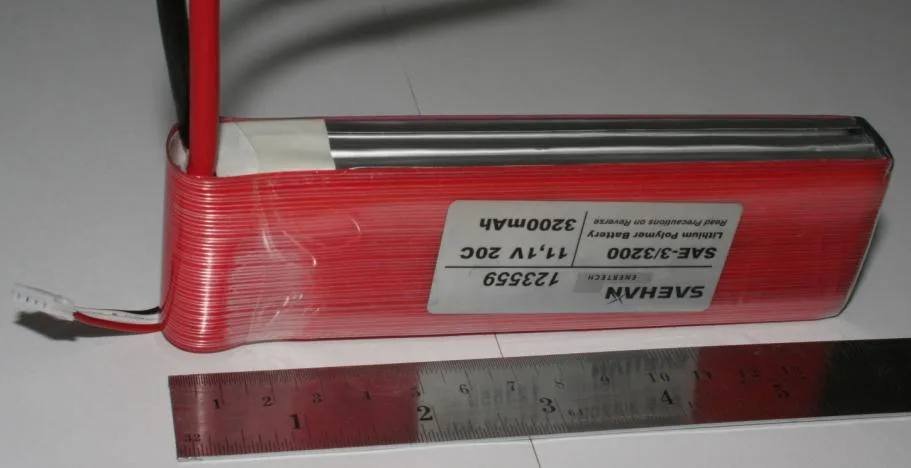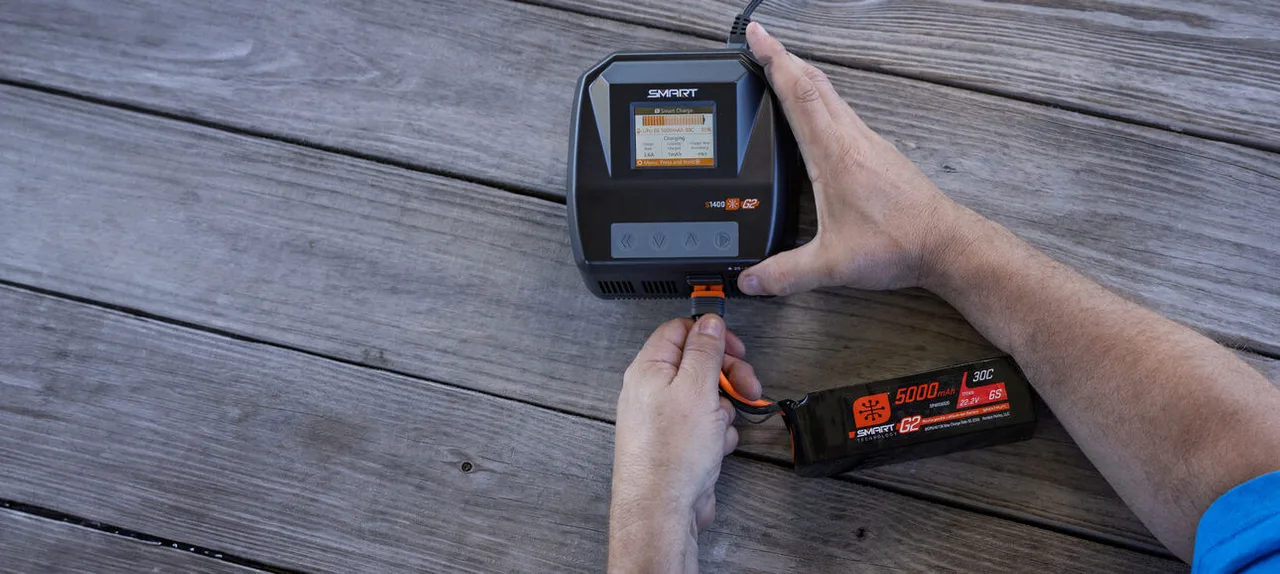
Manufacturer connection demonstration on a wooden bench, not a recommended charging station. Do not read the pictured surface or missing containment as safety guidance; follow the exact battery and charger manuals.
Horizon Hobby (photographer not identified) · Manufacturer copyright; permission required before public release
Photo credit & source ↗From the September 2026 research edition. Product details and prices are dated source records; confirm the exact model and manual before buying or making changes.
Lithium polymer (LiPo) batteries are what make modern brushless RC cars so fast, but they store a lot of energy in a small package. Treated properly, they are an everyday part of the hobby. Charged carelessly, damaged or pushed past their limits, they can overheat and catch fire.
This guide collects official guidance from battery makers and fire authorities. It covers how to set up a safe charging spot, what to watch for while charging, what to do if a battery starts to fail, and how to get rid of damaged packs. We also cover two recent U.S. recalls of hobby battery chargers.
Where sources disagree, we say so. Where we could not find authoritative evidence, we say that too. This article is general safety information, not a substitute for your battery's manual or your local fire service's advice. If you ever see smoke or fire, get people away and call 911 (or your local emergency number).
Key takeaways
- Use a LiPo balance charger and the correct chemistry setting. Traxxas warns never to charge LiPo on a NiMH charger or NiMH mode.
- Charge at no more than 1C unless the maker says otherwise, and never charge a pack that is cold (below 40 °F) or hot to the touch, per Horizon Hobby's safety sheet.
- Charge on a non-flammable surface, away from flammables, bedrooms and exits. Plug the charger directly into a wall outlet, as FDNY advises.
- If a battery is failing: stop, move it away from anything that can burn only if it is safe to do so, and call 911 (FDNY guidance).
- Stop using swollen or damaged packs and dispose of them according to local rules. Never put lithium batteries in household trash.
- Check for recalls. The CPSC recalled HTRC C240 chargers in 2024 and HTRC/Haisito T400 chargers in 2026 over fire hazards.
Before you charge
Use the right charger and settings
Traxxas is blunt: "NEVER charge a LiPo battery using a NiMH charger (or a NiMH charging mode...)." It also warns that failing to use a LiPo balance charger "can result in explosion, fire, and personal injury." A balance charger monitors and evens out each cell, not just the total pack voltage.
Match the setting to the chemistry. Standard LiPo cells top out at 4.2 V per cell, according to Gens Ace. LiHV packs charge to 4.35 V per cell, according to cell maker Grepow. Charging a standard LiPo on a LiHV setting overcharges it.
FDNY's general advice for lithium-ion devices is to use the manufacturer's charger and batteries and to look for a UL mark. That page is written for all lithium-ion devices, including e-bikes, but the principle applies to RC gear too.
Check the charge rate
Horizon Hobby's lithium battery safety sheet for Spektrum packs says to charge at no more than 1C unless the battery maker says otherwise. Gens Ace likewise says to charge at 1C or the rate on the label. For a 5000 mAh pack, 1C is 5 A. Some packs are rated higher (Spektrum rates its SPMX53S30 3S 5000 mAh Smart G2 pack for up to 5C), but only use a higher rate if your pack's maker specifically allows it.
Check the battery
Look the pack over before it goes on the charger. Horizon's safety sheet says to "discontinue use and dispose of damaged or swollen batteries immediately." Watch for puffing, dents, torn wrap, damaged wires or connectors, and a pack that has taken a hard crash.
Check the temperature too. Horizon says not to charge below 40 °F (4 °C) or when the pack is hot to the touch (above 100 °F). Gens Ace says never to charge below freezing or while the pack is hot. After a run, let the pack cool first.
Check the voltage. Horizon's TRI LiPo safety sheet says individual cells must be at least 3 V before charging or use. A pack that has been drained below that is a candidate for retirement, not a rescue attempt.
Choose a safer charging spot
FDNY's lithium-ion tips, together with guidance from battery makers, point to a spot like this:
- Charge outside if possible (FDNY). If you charge indoors, pick a spot on a non-flammable surface.
- Not in a bedroom or near exits (FDNY). A fire should never block your way out.
- On the floor (FDNY), away from things that can burn. Gens Ace also says to charge in an open area away from flammables.
- Plug directly into a wall outlet, with no extension cords (FDNY).
- Keep batteries at room temperature, out of direct sunlight (FDNY).
- Use a container. Traxxas tells users to charge LiPo in a fire-retardant or fireproof container, and Horizon says to store packs in a "non-conductive and fireproof container."
A note on LiPo bags and ammo cans: battery makers recommend fireproof containers, but we did not find any independent or authoritative test showing how well consumer LiPo bags or similar containers perform. Treat a container as one layer of protection, not a guarantee, and still follow the location advice above.
A working smoke alarm near where you charge is also a sensible step.
While charging
- Stay nearby and check on it. A charging battery is the one you want to be able to see. The London Fire Brigade says many e-bike and e-scooter battery fires happen during charging. Its page is about those products, not RC packs, but the lesson about paying attention during charging carries over.
- Watch for warning signs. FDNY lists "odors, changes in shape or color, leaking, or odd noises."
- Feel for heat, carefully. A pack getting unusually hot during charging is a reason to stop the charge at the charger or wall outlet, if you can do so safely.
- Don't charge on car seats, carpets or couches. Keep it on that non-flammable surface.
When charging finishes, unplug the pack. If you will not run it within a few days, use your charger's storage mode instead of leaving it full.
If something goes wrong
A battery is swelling, smoking, hissing or smells odd
FDNY's guidance for a failing lithium-ion battery is: "discontinue use immediately. If it is safe to do so, move the device away from anything that can catch fire and call 9-1-1."
Note the condition: only if it is safe. Do not pick up a smoking or burning pack. The London Fire Brigade warns that lithium battery fires "produce intense fires that spread rapidly" with "toxic smoke."
If there is fire
- Get everyone out, including pets, and close doors behind you if you can.
- Call 911 or your local emergency number.
- Do not go back in.
A conflict you may see in manuals
Horizon Hobby's lithium safety sheet says: "In the event of fire, immediately call emergency services as only a Class D, dry chemical fire extinguisher must be used."
That wording is unusual. Class D is normally a classification associated with combustible metals, and none of the fire authorities we reviewed endorsed a Class D extinguisher for RC battery fires. FDNY's advice is to stop using the device, move it away from anything that can burn only if safe, and call 911. Both sources agree on the most important step: call emergency services. Our recommendation is to follow your local fire service's guidance, prioritize getting out, and let firefighters handle the fire rather than trying to fight a battery fire yourself.
Old folk remedies
You may see advice online to discharge a puffed pack in salt water. None of the battery makers or authorities we reviewed support that method, so we do not recommend it.
Disposing of damaged and old batteries
- Never in household trash or regular recycling. PHMSA, the U.S. hazardous materials safety agency, says not to put lithium batteries in the trash or general recycling. PHMSA also notes that damaged, defective or recalled batteries "have greater potential ... to short circuit, to release heat, or even to cause a fire."
- Follow local rules. Horizon says to dispose of damaged or swollen batteries according to local, state and national law.
- In New York City, FDNY says putting lithium-ion batteries in household trash or recycling is illegal. Take them to a Special Waste Drop-Off Site, and bag each battery or tape its terminals.
- In the EU, Gens Ace says to take waste batteries to a designated WEEE collection point.
Elsewhere, contact your local waste authority or fire department to find a drop-off site that accepts lithium batteries, and ask whether damaged packs need special handling.
Charger recalls to know about
A keyword search of U.S. Consumer Product Safety Commission (CPSC) recall data since 2019 turned up two hobby battery charger recalls:
| Recall | Date | Units | Hazard and incidents | Where and when sold | Remedy |
|---|---|---|---|---|---|
| HTRC C240 battery chargers (25-066) | Dec. 12, 2024 | About 34,600 | Chargers "can ignite or cause a connected battery to ignite"; 32 fire or thermal incidents, 5 with significant property damage, 1 injury | AliExpress, Amazon, Banggood, eBay, HTRC-Direct, RCGoing; Dec. 2017–June 2024; $65–$290 | Full refund |
| HTRC and Haisito T400 battery chargers (26-379) | April 2, 2026 | About 4,800 | 33 fires or explosions, 3 injuries, 12 incidents with $224,000 in property damage | AliExpress, Amazon, Banggood, eBay, Pyrodrone; March 2019–March 2026; about $130 | Refund plus prepaid disposal package |
If you own either charger, stop using it and follow the instructions on the CPSC recall page. Our search of CPSC recall data used keyword queries, so it is not exhaustive. Check cpsc.gov for your own charger and batteries. The London Fire Brigade also advises registering products so you receive recall alerts.
Common mistakes
- Charging LiPo on a NiMH mode, or a standard LiPo on a LiHV setting.
- Charging above the maker's rate, or charging at more than 1C when the maker gives no rate.
- Charging a hot pack straight off the car, or a cold pack in a winter garage.
- Charging on a bed, couch or carpet, or near the only exit.
- Using an extension cord or power strip instead of a wall outlet, against FDNY advice.
- Walking away from a charging pack.
- Continuing to use a swollen, crashed or damaged pack.
- Throwing dead packs in the trash.
- Trying to fight a battery fire instead of getting out and calling 911.
FAQ
Do I really need a LiPo bag?
Traxxas and Horizon recommend fireproof containers. We did not find independent tests of consumer LiPo bags, so use one as an extra layer, not as a replacement for a safe location and staying nearby.
What extinguisher should I keep for a LiPo fire?
Sources conflict. Horizon's sheet mentions a "Class D, dry chemical" extinguisher, which is unusual wording, while FDNY's guidance is to call 911 and move the device away only if safe. Follow your local fire service's advice and prioritize getting out.
Can I charge a slightly puffy pack one more time?
No. Horizon says to stop using and dispose of swollen batteries immediately.
How do I dispose of a dead LiPo?
Not in trash or regular recycling, per PHMSA. Use a local drop-off site that accepts lithium batteries. In NYC that means a Special Waste Drop-Off Site, with each battery bagged or its terminals taped.
What should I do if I own a recalled HTRC charger?
Stop using it and follow the remedy on the CPSC recall page: a full refund for the C240, and a refund plus a prepaid disposal package for the T400.
Sources
- FDNY Smart: Lithium-ion battery safety
- London Fire Brigade: Lithium batteries
- Traxxas: Battery Basics
- Traxxas: LiPo Batteries
- Spektrum: Lithium Battery Safety (PDF)
- Horizon Hobby: TRI LiPo Battery Safety Sheet (PDF)
- Gens Ace (Genspow EU): LiPo Battery Guide
- Grepow: LiPo vs LiHV battery
- Spektrum: 11.1V 5000mAh 3S 30C Smart G2 LiPo (SPMX53S30)
- PHMSA: Lithium Batteries
- CPSC: HTRC C240 Battery Chargers Recalled
- CPSC: HTRC and Haisito T400 Battery Chargers Recalled
- SaferProducts.gov recall data (charger query)