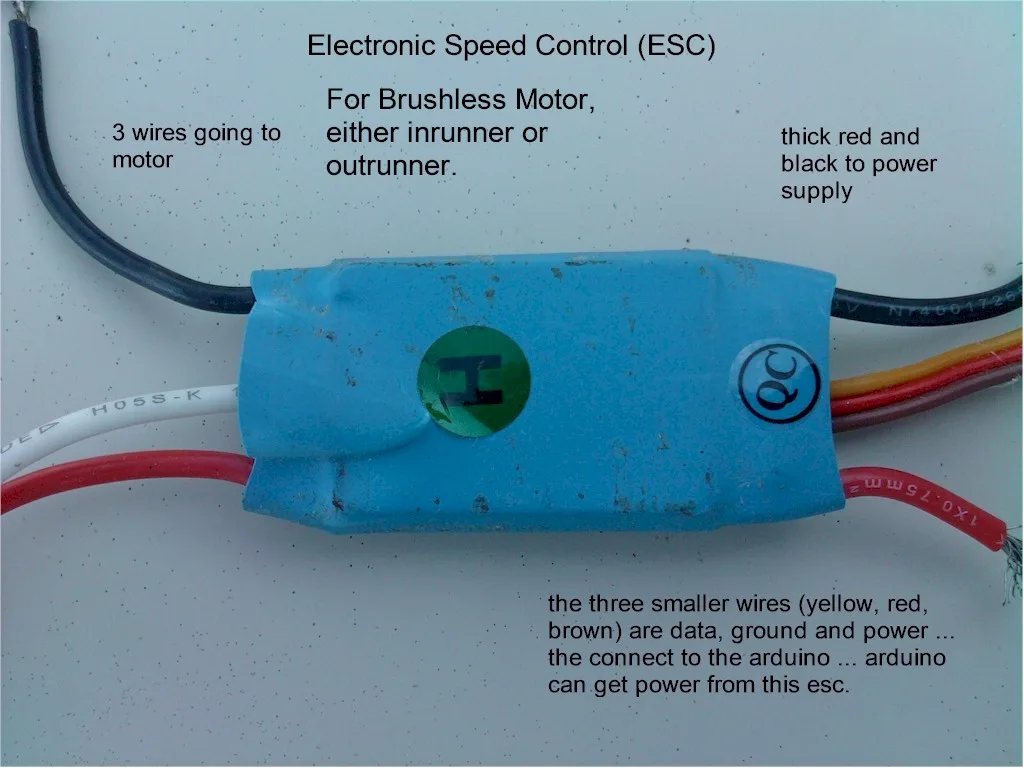
A three-wire brushless ESC photograph by 1sfoerster. Generic hobby-electronics context, not a car-specific compatible setup.
1sfoerster · CC BY-SA 3.0
Photo credit & source ↗From the September 2026 research edition. Product details and prices are dated source records; confirm the exact model and manual before buying or making changes.
The electronic speed control (ESC) turns a trigger pull into motor power. It often powers your receiver and steering servo too, and it protects your LiPo battery from running too low. Pick the wrong one and you can end up with a servo that browns out, a battery that gets over-discharged, or an ESC that fails early.
Spec sheets don't make it easy: brands rate current in different ways, and some list no rating at all. This guide explains the specs that matter: voltage, current, BEC and low-voltage cutoff (LVC). It covers the LVC settings manufacturers publish and the causes of ESC failure they name, and it compares current ESCs at list prices as of September 17, 2026.
Key takeaways
- Start with voltage (cell count) and motor type (sensored, sensorless or brushed). Then look at current rating.
- Amp ratings aren't comparable across brands. Hobbywing lists continuous/peak, Tekin lists "per phase," and Castle's Copperhead 10 page lists none.
- A strong, adjustable BEC (for example 6/7.4/8.4 V) matters if you run a powerful high-voltage steering servo.
- Keep LVC turned on for LiPo. Published cutoffs include 3.2 V/cell (Castle Auto-LiPo, Traxxas LVD, Tekin's RSX default) and a 2.8/3.1/3.4 V/cell choice on the Hobbywing MAX10 G2.
- Hobbywing names overloading as the most common cause of ESC damage. Manufacturers also warn about bad gearing, reverse polarity, ripple, water and over-voltage.
Step 1: Match voltage and vehicle class
Every ESC has a maximum input voltage, usually given as a LiPo cell count. Exceeding it is one of the causes Castle lists as not covered by warranty ("over voltage" and "running outside of MAX voltage/current"). Horizon Hobby warns that "each RC car's power system has a defined voltage limit."
Examples from current products:
- Hobbywing EZRun MAX10 G2 80A: 1/10, 2–3S
- Hobbywing EZRun MAX10 G2 140A: 1/10, 2–4S
- Castle Copperhead 10: 1/10, 2–4S (16.8 V)
- Castle Mamba X: 1/10, 2–6S (25.2 V)
- Spektrum Firma 160A Smart ESC V2: 1/8–1/7, 3–8S
Some makers also tie motor Kv to cell count. Hobbywing's MAX10 G2 manual recommends "KV≤ 6000" on 2S and "KV≤ 4200" (3652-size motor) on 3S for the 80A version. For the 140A, it says "KV≤ 4000" (3665 size) on 3S and "KV≤ 2600" (4268 size) on 4S. If your motor is outside that guidance, choose a bigger ESC or a different motor.
Step 2: Match the motor type
- Sensorless brushless: common in bashers, such as the Velineon V3200 in Traxxas's 2026 Slash 4X4 Brushless.
- Sensored brushless: smoother low-speed control. Castle says sensors let the ESC "start the motor at very low RPMs with no 'cogging'." Big Squid RC rules out sensorless brushless for crawlers for this reason.
- Spec racing: some ESCs have a zero-timing "blinky" mode for spec classes. Tekin's RSX manual describes "Spec Mode activated. Sensored-Only, no Timing or Boost. ROAR Legal."
- Brushed: some ESCs handle both. Tekin's RX8 Gen3 is listed as a sensored brushless/brushed ESC.
Step 3: Understand current ratings
Continuous current is what the ESC can carry steadily. Peak or burst current is a brief maximum. Hobbywing's EZRun MAX10 G2 examples:
- 80A version: 80 A continuous / 520 A peak
- 140A version: 140 A continuous / 880 A peak
Other brands rate differently. Tekin's RX8 Gen3 lists "300 amps per phase" and "1000 amps per phase" burst. Castle's Copperhead 10 page gives no current rating at all. Because these are measured and described differently, don't compare amp numbers across brands. Use each maker's recommended motor, cell count and vehicle class instead.
No rating protects against overloading. Hobbywing says "The most common reason for your ESC / Motor damage is found by 'overloading'."
Step 4: Check the BEC
The BEC (battery eliminator circuit) powers your receiver and steering servo from the drive battery, so you don't need a separate receiver pack. A higher-voltage, higher-current BEC can support a strong high-voltage servo. Hobbywing lists the MAX10 G2 and MAX8 G2S BECs as switch-mode; check each listing for the others:
| ESC | BEC voltage | BEC current |
|---|---|---|
| Hobbywing MAX10 G2 | 6 V / 7.4 V adjustable | 5 A continuous |
| Hobbywing XR10 Pro G3 | 5–7.4 V | 5 A |
| Tekin RSX Pro | 6 / 7.4 V | 5.5 A |
| Castle Copperhead 10 | 5.5 / 7.5 V | 6 A peak |
| Castle Mamba X | 5.5–8.0 V adjustable | 8 A peak |
| Hobbywing MAX6 G2 | 6 / 7.4 / 8.4 V | 8 A continuous / 25 A peak |
| Spektrum Firma 160A V2 | 6 V or 8.4 V | 8 A continuous |
| Tekin RX8 Gen3 | 6 / 7.4 V | 8 A |
| Hobbywing MAX8 G2S | 6 / 7.4 / 8.4 V adjustable | 10 A |
Check your servo's rated voltage before choosing a BEC setting. Setting the BEC above what the servo is rated for can damage it. Note that Castle quotes peak BEC current here, while Hobbywing's MAX10 G2 and MAX6 G2 and Spektrum's Firma 160A list continuous current, and some listings don't say which.
Step 5: Low-voltage cutoff (LVC)
LVC protects LiPo packs. Spektrum's Firma manual says LVC "is mainly for preventing LiPo packs from being over-discharged." When voltage drops below the threshold, the ESC reduces or cuts power.
LVC settings manufacturers publish
| ESC / brand | Published setting | Source wording |
|---|---|---|
| Castle (Cobra 5 guide) | Auto-LiPo: 3.2 V per cell | "will automatically set the cutoff to 3.2 volts per cell detected" |
| Tekin RSX | Factory default 6.4 V for 2S (3.2 V/cell) | "Factory default voltage cutoff is set for a 2S LiPo battery @ 6.4V" |
| Traxxas (Battery Basics) | Warns below 3.2 V/cell | Traxxas says to turn Low-Voltage Detection on for LiPo |
| Traxxas VXL-3s/6s/8s | Two-stage low-voltage detection | Product pages |
| Hobbywing MAX10 G2 | Low/medium/high: 2.8, 3.1 or 3.4 V/cell | "2.8V/Cell, 3.1V/Cell and 3.4V/Cell respectively" |
| Spektrum Firma 2-in-1 | Output drops to 50%, then cuts after 10 seconds below threshold | Manual |
How to set it
- Never disable LVC with LiPo. Castle is blunt about its "disabled" setting: "Do not use this setting with any Lithium pack!" Traxxas says over-discharging an iD LiPo "will cause irreparable damage and may cause battery failure."
- Watch the lowest settings. Gens Ace says to "Never discharge battery to a level below 3V per cell under load." Hobbywing's lowest MAX10 G2 option (2.8 V/cell) is below that figure, so the medium (3.1 V) or high (3.4 V) option lines up better with battery-maker guidance.
- Horizon's battery safety sheet says cells should be at least 3 V before charging or use.
Step 6: Features that change how it drives
- Drag brake: Tekin says it "provides immediate braking action in neutral." Castle's "Crawler Full On" setting "applies full brake at neutral throttle to prevent crawler-type vehicles from rolling." Spektrum warns: "Drag brakes will consume more power and heat will be increased, start with small values."
- Punch: Spektrum says punch "Determines how quickly power is applied when the throttle trigger is quickly moved to the full throttle position." Hobbywing's MAX10 G2 offers punch "in 1-9 stages, the higher the set value, the faster the acceleration."
- Timing, boost and turbo: the MAX10 G2 supports "Turbo timing adjustment of up to 32 degrees." Castle says "Generally, low advance gives more efficiency and less power."
- Programming and data: Hobbywing uses a program card, LCD box or OTA module, and its MAX6 G2 and MAX8 G2S have built-in Bluetooth for the HW Link app. Castle uses Castle Link on USB or through a B-LINK Bluetooth adapter (sold separately), with data logging. Traxxas uses one-button EZ-Set, with telemetry through the Traxxas Link wireless module. Spektrum Smart ESCs send telemetry to Spektrum transmitters. Tekin uses HotWire.
Current ESCs and list prices
Prices were shown on manufacturer or official stores on September 17, 2026. Several are sale prices, and prices change often.
| ESC | Class / cells | Key specs | Price shown |
|---|---|---|---|
| Hobbywing EZRun MAX10 G2 80A | 1/10, 2–3S | 80 A / 520 A. BEC 5 A. IP67 | $49.99 |
| Hobbywing EZRun MAX10 G2 140A | 1/10, 2–4S | 140 A / 880 A. Turbo up to 32° | $89.99 (page also shows $99.00 MSRP) |
| Traxxas VXL-3s (3355R) | 1/10, 2–3S | Thermal shutdown. Two-stage LVD. Over-voltage protection | $109.95 |
| Castle Copperhead 10 | 1/10, 2–4S | Sensored, waterproof (fan is not) | $144.95 (list $177.35); temporarily out of stock |
| Hobbywing EZRun MAX6 G2 | 1/6–1/7, 3–8S | BEC 8 A. Bluetooth | $159.99 (reg. $212) |
| Traxxas VXL-6s (3485T) | 4–6S | Fan-cooled. Two-stage thermal and LVD | $159.95 |
| Castle Mamba X | 1/10, 2–6S | 8 A peak BEC. Data logging | $189.95 (list $232.45) |
| Spektrum Firma 160A Smart V2 | 1/8–1/7, 3–8S | 160 A / 1050 A burst. Smart telemetry | $189.99 |
| Hobbywing XR10 Pro G3 | 1/10 modified racing, 2S | 160 A / 1200 A. For 3.5T–10.5T. Reverse polarity protection | $219.99 (from $310) |
| Tekin RX8 Gen3 | 1/8, 2–6S | 300 A/phase. BEC 8 A | $219.99 MSRP; out of stock |
| Hobbywing EZRun MAX8 G2S | 1/8, up to 6S | BEC 10 A. Bluetooth data logging | $220 MSRP (sale price not captured) |
| Traxxas VXL-8s (3496T) | X-Maxx class | 10 AWG wire. Fan. Two-stage LVD | $249.95 |
The Tekin RSX Pro (1/10, 2–3S LiPo, 210 A/phase, blinky mode) didn't show a price on the page we checked.
Why ESCs fail, according to manufacturers
- Overloading and wrong gearing. Hobbywing names overloading as the most common cause. Castle's warranty excludes "over voltage, overloading, improper gearing or propping."
- Reverse polarity. Hobbywing's MAX10 G2 manual: "If the connection is reversed, the ESC will be damaged." Castle: reverse polarity "WILL damage your ESC." Tekin: "Tekin ESCs are not protected from reverse polarity." One exception we found: the Hobbywing XR10 Pro G3 lists reverse polarity protection.
- Missing capacitors and ripple. Tekin says the RSX's power capacitor "MUST BE MOUNTED on the ESC for proper operation." Leaving it off voids the warranty and can cause damage "beyond repair." Castle says "Ripple voltage is extremely hard on an ESC," that it "should always be less than 10% of the total pack voltage," and that longer battery leads add inductance and ripple.
- Water. Tekin says most of its ESCs "should not be used in or around water." Castle treats "water submersion" as non-warranty and says the cooling fan on its waterproof ESCs "must be removed prior to driving in wet conditions."
- Over-voltage. Castle's warranty excludes it. The Traxxas VXL-3s includes battery over-voltage protection.
- Heat. Hobbywing's FAQ says its ESCs are designed to perform up to 70 °C, with 80 °C the highest.
- Wiring and modifications. Castle's warranty also excludes "incorrect wiring," "improper motor selection, incorrect controller settings, insufficient batteries, or inadequate connectors," poor solder joints, and modifications such as potting.
Common mistakes
- Comparing amp ratings across brands as if they were the same measurement.
- Plugging in a battery backward. Double-check polarity, especially when soldering new connectors.
- Extending battery wires without addressing ripple. Castle says its CapPack can offset "up to 12 inches" of extra battery lead.
- Turning LVC off, or setting it too low, with LiPo.
FAQ
How many amps does my ESC need?
Follow the ESC maker's guidance for your motor Kv, cell count and vehicle class rather than a single amp number. Ratings are defined differently across brands.
What BEC do I need for a high-voltage servo?
One whose voltage setting matches the servo's rating, with enough current. Options range from 5 A (Hobbywing MAX10 G2) to 10 A (Hobbywing MAX8 G2S).
What should I set low-voltage cutoff to for LiPo?
Several manufacturers use 3.2 V per cell (Castle Auto-LiPo, Tekin RSX default, Traxxas LVD warning). Avoid settings below 3.0 V/cell, which Gens Ace says never to go under.
Is a waterproof ESC safe in water?
Check the fine print. Castle requires removing the fan on its waterproof ESCs before wet driving, and Tekin says most of its ESCs shouldn't be used around water.
Do I need a sensored ESC?
For brushless crawling, generally yes: Big Squid RC's 2014 crawler column rules out sensorless because of cogging. Newer FOC crawler systems are covered in our FOC crawler electronics post. Spec racing modes such as Tekin's are "Sensored-Only." For bashing, sensorless is common.
Sources
- HobbywingDirect: EZRun MAX10 G2
- Hobbywing MAX10 G2 manual (PDF)
- HobbywingDirect: EZRun MAX6 G2
- HobbywingDirect: EZRun MAX8 G2S
- HobbywingDirect: XR10 Pro G3
- HobbywingDirect: Overloading your gears
- HobbywingDirect FAQ
- Castle Creations Mamba X
- Castle Creations Copperhead 10
- Castle Creations Cobra 5 DEG (PDF)
- Castle Creations warranty and service
- Castle Creations: Ripple voltage blog
- Castle Creations: Motors, sensored vs. sensorless
- Castle Creations Motor User Guide V4 (PDF)
- Tekin RSX manual (PDF)
- Tekin RSX
- Tekin RX8 Gen3
- Tekin FAQ
- Big Squid RC: Brushed vs. brushless (crawlers)
- Spektrum Firma 160A Smart ESC V2
- Spektrum SPMXSEM0500 manual (PDF)
- Traxxas Slash 4X4 Brushless
- Traxxas VXL-3s ESC
- Traxxas VXL-6s ESC
- Traxxas VXL-8s ESC
- Traxxas Battery Basics
- Traxxas LiPo batteries article
- Horizon Hobby: How fast can fast RC cars go?
- Horizon Hobby TRI LiPo Battery Safety Sheet (PDF)
- Gens Ace LiPo battery guide