Keep weight low, verify exact fit, and compare one change on the same obstacle before adding more mass.
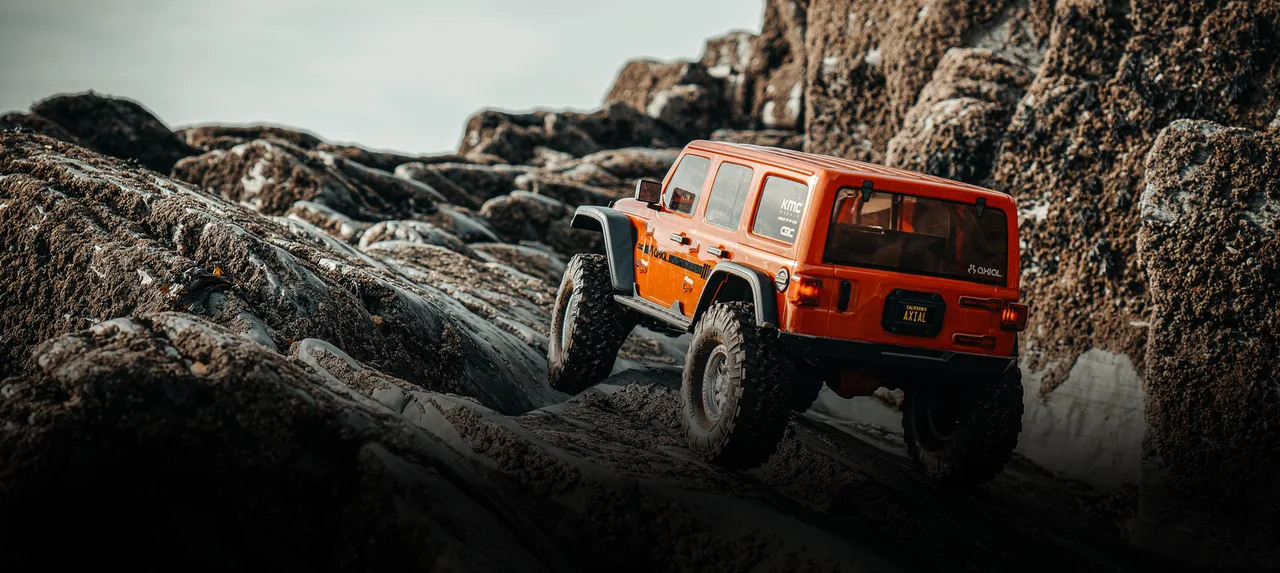
Official Axial adventure photography for trail context; water resistance and component specification are not established by the image. Source page: My Axial Adventure — Wales.
Axial Adventure / Horizon Hobby (official page; individual photographer not credited) · Copyrighted official editorial/product imagery; reuse permission not established
Photo credit & source ↗View the teaching schematic
Goal
Start with the crawler clean, battery disconnected and stock weight distribution noted. A crawler’s response on a climb or sidehill depends on terrain, tire, wheelbase, suspension, throttle control and where mass sits—not a single brass part. Axial’s crawler glossary says crawlers typically use forward weight bias and identifies brass as a material used to lower center of gravity. Axial crawler glossary Treat that as a design direction, not a universal percentage or purchase instruction.
Check the stock layout
First inspect what is already low and forward: battery position, motor/transmission location, axle hardware, wheel/tire assembly and body accessories. Confirm full steering and suspension travel with the vehicle powered down. Any added mass must clear links, tires, driveshafts and wires through the whole travel range. Use only components confirmed for the exact platform; “fits SCX” is not enough when versions, axle formats and wheel interfaces differ.
Test one verified location
Separate chassis/axle mass from rotating wheel mass in your notes. Axial’s Rock-Tek product documentation explains that conventional rotating wheel weight adds rotating mass and can affect driveline load and throttle response, while its own specialized system is designed differently. Axial/Pro-Line Rock-Tek documentation This is manufacturer product context, not evidence that any mass amount is right for another rig.
Use a simple test order. Pick one familiar obstacle or sidehill, drive it stock several times, then add one verified, securely mounted change. Repeat at similar battery state and tire condition. Record the location, whether the change rotates, clearance at full steering/compression, and the observed tradeoff. Hypothetical example: moving an approved battery mount forward improves a particular climb but makes the rear unload earlier on a descent. That is a result for that crawler and course, not a rule for all crawlers.
Stop if a weight contacts a tire, link or driveshaft; makes steering bind; loosens during a run; overloads a mount; or changes the vehicle in a way the manual does not support. Do not stack random mass to solve a line-choice or tire issue. The aim is a reversible, documented balance experiment with the exact body format and terrain stated. If you cannot confirm fitment from the manufacturer documentation, keep the stock arrangement and consult the exact manual or support record.
Controlled comparison
More mass can also alter recovery and stress where it is mounted. This guide assigns no quantity because chassis, axle, tire and terrain change the result. Hold battery location and body configuration constant during a test, then check fasteners and hand-turn the drivetrain afterward. A stable stock crawler is a better baseline than a modified one with unknown clearance.
Stop criteria
Stop the experiment if a mount flexes, a wheel weight contacts a link, steering slows or binds, or a fastener loosens. These findings say the location is unsuitable for that exact build. Remove the change, return to the stock baseline, and document the interference rather than adding another part to compensate.
Leave with a useful record.
This is a reading aid, not a safety certification. Checks stay only on this page and reset when you reload.
Sources & scope
Primary references checked September 19, 2026. These dates describe source review, not publication of this site. Examples labelled hypothetical or illustrative are not tests.
Axial Adventure — Axial RC Crawler Glossary
Supports: crawlers typically use forward weight bias; brass is used to lower center of gravity.
Limit: No universal mass percentage or fitment claim is implied.
Source publication: not established · Checked: 2026-09-19
Axial Adventure / Pro-Line Racing — Pro-Line Rock-Tek Tire Weight System
Supports: rotating wheel mass is distinct from stationary chassis-relative mass; weight placement is a product-specific design consideration.
Limit: Product claims and compatibility apply only to the listed system.
Source publication: not established · Checked: 2026-09-19