Photo credit & source ↗
BENCH GUIDE 3 MIN READ
Place crawler weight with the whole vehicle in mind
A cautious way to evaluate low and forward mass without assuming every crawler wants the same balance.
Open the guide ↗Tread, compound, carcass and diameter interact with the track, temperature, vehicle and setup. This chooser teaches tradeoffs; it does not produce a grip score or a product recommendation.
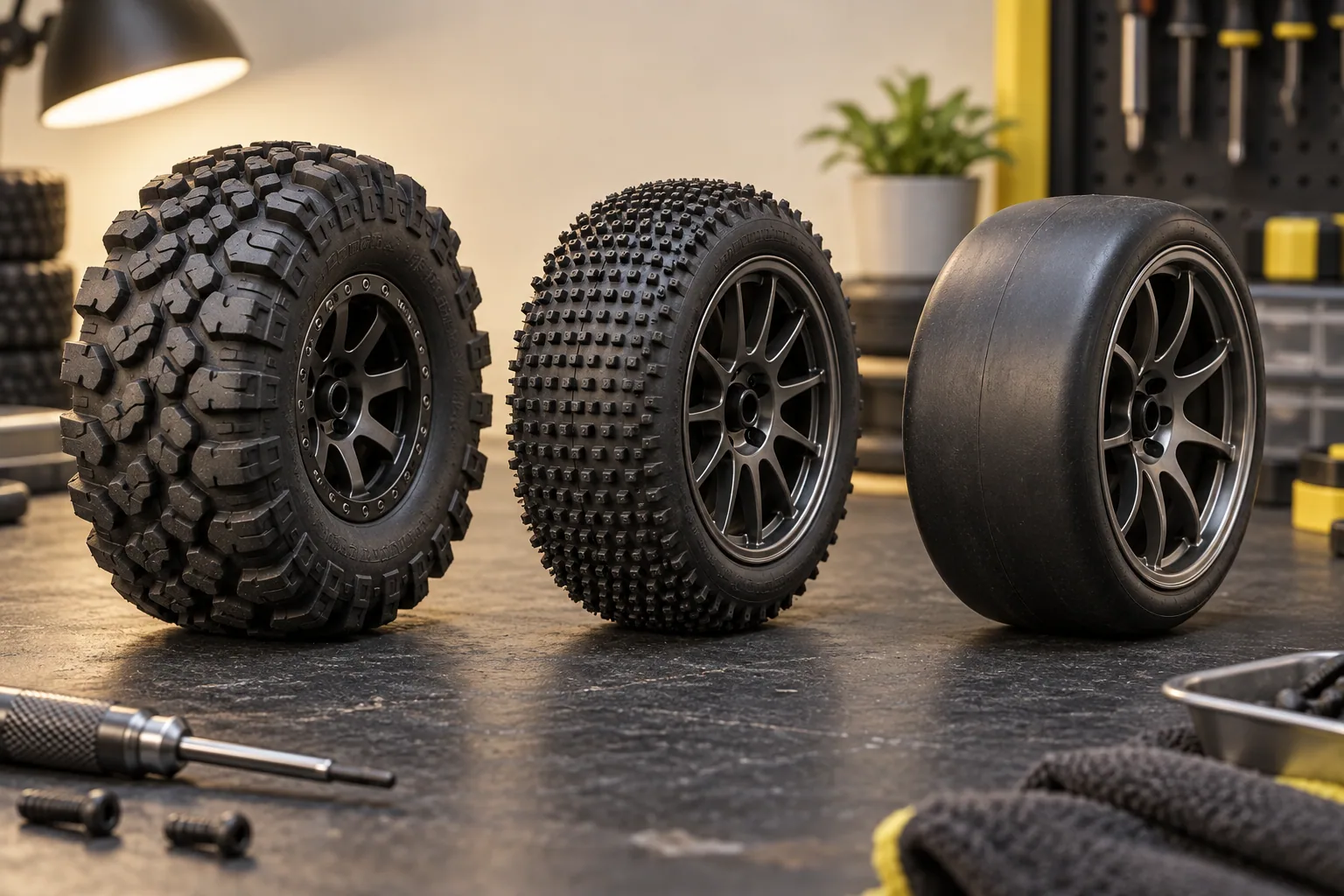
Manufacturer catalogues themselves distinguish tread patterns, compound/hardness and intended surface. For example, Pro-Line describes block tread as self-cleaning on loose surfaces, while its crawler listings identify tire format and compounds. Conditions still decide the result. Pro-Line product notes ↗ Pro-Line crawler catalogue ↗
Rollout is circumference: π × tire diameter. With the same wheel RPM, a larger effective diameter covers more distance per turn. Traxxas illustrates this with 13 in versus 14 in rollouts and compensating pinion choice; its gearing guidance also warns that speed-focused gearing raises load and heat. Traxxas rollout example ↗ Traxxas gearing note ↗
Animation is illustrative and opt-in. It remains paused when reduced motion is preferred.
Support changes how a tire holds shape and responds under load. More support can change steering feel and stability; less support can conform differently. There is no universal “better” setting: terrain, mass, speed, temperature and the rest of the setup matter. Keep the exact tire, wheel and insert together in your notes.
Model assumptions: a circular, no-slip tire; constant entered wheel RPM; the diameter supplied by the reader. The calculator reports geometry, not predicted speed, temperature, traction or compatibility.
A cautious way to evaluate low and forward mass without assuming every crawler wants the same balance.
Open the guide ↗A measured, manual-led first pass that separates alignment from every other setup change.
Open the guide ↗A faster lap is a clue, not a verdict. Compare repeatable runs, record mistakes and return to the baseline before drawing a conclusion.
Open the guide ↗