Working steering narrows the path; it does not prove the ESC, motor or drivetrain is good.
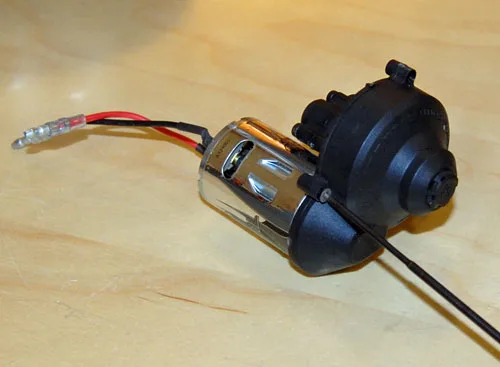
Manufacturer workshop image: motor fitted to a closed Axial transmission.
Specific Axial motor/transmission fitment; the image does not show final gear mesh.
Axial Adventure; Bender's AX10 Ridgecrest Stage 3 (photographer not identified) · Manufacturer copyright; permission required before public release
Photo credit & source ↗View the teaching schematic
Working steering is useful evidence, but it proves only that part of the radio and power path is functioning. It does not establish that the throttle channel is configured, the ESC is armed, the motor path is intact or the drivetrain can turn. Diagnose one link at a time.
Capture the symptom without extended throttle
Place the car on a stable stand or use the manufacturer’s restraint method, with driven wheels clear. Follow the documented power-up order. Without touching wiring, note receiver indication, steering response, ESC lights or tones and whether a brief minimum throttle input produces motor sound or wheel motion. Return to neutral, switch off and disconnect the drive battery. Do not hold throttle while listening or probing.
Divide the chain into checkpoints
Start with radio state: correct transmitter model memory, throttle trim and channel assignment as specified by the manual. Next inspect, unpowered, the ESC receiver lead orientation, battery and motor connectors, pin seating and visible wire damage. Do not tug wires or rearrange pins by colour. Then compare the ESC indication with its exact manual; an unfamiliar light or tone is a question to resolve, not permission to run a generic calibration sequence.
An older official ECX troubleshooting table lists transmitter or vehicle power state, low transmitter power and a discharged vehicle battery among model-specific no-operation checks. ECX2000S manual. Use those categories as prompts only; its codes and remedies do not diagnose a different ESC or vehicle.
Check mechanics with all power removed
Follow the vehicle manual before separating motor and drivetrain components. Where its procedure permits, roll the vehicle and rotate accessible driveline parts gently by hand. Record whether the bind is constant, occurs once per revolution or appears at one steering position. A mechanical bind, stripped gear or seized bearing needs mechanical service. A freely moving drivetrain merely removes one suspicion; it does not prove that the ESC or motor works.
Use a branching record
If the receiver shows no normal state, return to radio power, binding and compatibility documentation. If steering is normal but the ESC does not reach its stated ready state, investigate its documented input, battery and arming conditions. If the ESC indicates normal operation but the motor path is silent, record connectors and motor observations for manufacturer support. If the motor sounds but wheels do not move, the manual-defined drivetrain path becomes the focus.
Stop for a swollen or uncertain battery, heat, odor, exposed conductor, moisture, unknown error indication or a drivetrain that will not move freely. Do not swap random components or bypass connectors as a test. A good escalation note includes exact models, power-up sequence, indications, one brief observed response and the unpowered hand check—enough evidence for a shop or manufacturer to choose the next safe test.
Leave with a useful record.
This is a reading aid, not a safety certification. Checks stay only on this page and reset when you reload.
Sources & scope
Primary references checked September 19, 2026. These dates describe source review, not publication of this site. Examples labelled hypothetical or illustrative are not tests.
Spektrum / Horizon Hobby — ECX2000S manual
Supports: Example no-operation troubleshooting categories and bind troubleshooting..
Limit: Older model-specific manual; exact LED codes and repairs differ.
Source publication: not established · Checked: 2026-09-19