A used car can be promising without being ready; document what is known and stop at unsafe uncertainty.
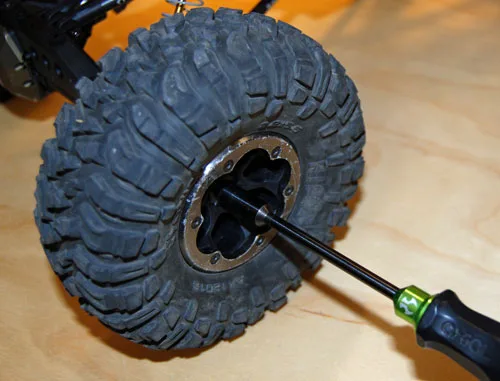
Manufacturer workshop image: wheel-and-axle service on an Axial Ridgecrest crawler.
Specific to the pictured Axial build; do not infer hub, axle or wheel hardware compatibility.
Axial Adventure; Bender's AX10 Ridgecrest Stage 3 (photographer not identified) · Manufacturer copyright; permission required before public release
Photo credit & source ↗View the teaching schematic
A used RC car can be promising without being ready to run. Treat the inspection as an editorial checklist, not as a manufacturer certification or buying guarantee. The goal is to separate confirmed condition from unknown history and to price your own uncertainty before power is applied.
Establish identity before condition
Record the chassis model and revision, motor, ESC, receiver, transmitter and included battery as separate items. A body shell or transmitter badge does not identify everything underneath. Ask for the manuals, receipts and modification notes, but mark absent history as unknown rather than interpreting it as proof of neglect. Manufacturer assembly material can help identify component relationships; for example, the TT-02 manual shows model-specific assemblies, but it does not support a claim about the condition or value of a second-hand car. Tamiya TT-02 reference manual.
Inspect unpowered in four passes
First, look at structure: chassis, arms, mounts, towers and housings. Second, move wheels, steering and suspension gently by hand and note roughness, excess movement or contact points. Third, inspect wiring and connectors for exposed conductors, improvised joins, pinching or heat discoloration. Fourth, inspect the battery separately according to its maker’s guidance. Do not open a gearbox or dismantle electronics simply to complete the checklist.
Use three lists: confirmed working, requires inspection and unknown. “Steering moves freely by hand” belongs in the first; “right-front wheel has detectable play” belongs in the second; water exposure, battery age and modification history may remain in the third. Photograph the chassis bottom, connectors, suspension mounts and drivetrain before cleaning removes evidence.
Decide whether a powered check is justified
Do not power the car if the battery is damaged or of unknown safe condition, insulation is cut, moisture is present, connectors are hot-looking, or radio compatibility is unresolved. If the exact manuals, compatible transmitter/receiver and a known-good appropriate battery are available, place the vehicle on a stable stand or use the manual’s restraint method. Keep driven wheels clear. Use small steering inputs and only the minimum throttle input needed to observe response; never hold the vehicle or touch wiring during throttle.
Convert findings into a decision
After power-down and battery removal, update the three lists. A rough wheel, unfamiliar ESC signal, hot smell, intermittent connector or no-drive symptom needs a defined diagnostic step, not a longer test drive. Estimate parts availability and support before agreeing that a repair is minor.
Distinguish different readers’ thresholds. A newcomer may reasonably require a complete stock manual, known radio match and shop-verifiable battery. An experienced builder may accept missing electronics as a project while still rejecting structural damage or unsafe wiring. Neither threshold converts an unknown into a confirmed fault or a promised bargain.
Walk away or seek a shop assessment when battery safety, wiring repairs, structural damage or undocumented electronics exceed your competence. The checklist reduces ambiguity; it cannot reveal hidden wear or certify future reliability.
Leave with a useful record.
This is a reading aid, not a safety certification. Checks stay only on this page and reset when you reload.
Sources & scope
Primary references checked September 19, 2026. These dates describe source review, not publication of this site. Examples labelled hypothetical or illustrative are not tests.
Tamiya — TT-02 Chassis Instruction Manual
Supports: Manufacturer assembly diagram and model-specific component relationship context..
Limit: The articles are editorial workflows; exact tools, order and parts remain the readers own model manual.
Source publication: not established · Checked: 2026-09-19