A good first kit build has pauses for identification, fit checks and recordkeeping.
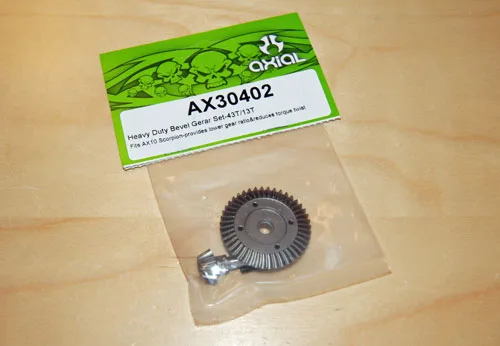
Manufacturer workshop image: packaged Axial heavy-duty bevel ring gear set.
Specific Axial bevel ring-gear replacement set; not a motor pinion/spur mesh reference.
Axial Adventure; Bender's AX10 Ridgecrest Stage 3 (photographer not identified) · Manufacturer copyright; permission required before public release
Photo credit & source ↗View the teaching schematic
A first kit build goes better when the manual controls the pace. The objective is not to empty every bag; it is to finish one defined assembly, verify what will soon be hidden and retain enough context to recover from a mismatch.
Prepare a build map
Read the exact kit manual once without assembling. Mark the stages for drivetrain, suspension, steering, electronics and body fit, plus every point where a part becomes enclosed. Tamiya’s TT-02 manual is a useful example of a staged manufacturer document: it pairs parts and hardware codes with assembly drawings and later adjustment checks. Those details apply to that kit, not as universal RC specifications. See the Tamiya TT-02 manual.
Inventory sealed bags and separately supplied electronics against the kit list before cutting anything open. Record a shortage while labels and packaging still establish where the part should have been. Set up trays for the current manual stage, completed subassemblies and unresolved parts; do not pour the full hardware set into one organizer and discard its labels.
Use a step card
For each stage, write: manual page, bag label, parts and hardware, orientation cue, compound or tool explicitly requested, and the movement to check before continuing. Photograph bearings, shims, pins, link orientations and wire routes before a cover hides them. Where the manual distinguishes screw types that look similar, keep them with their printed code until installed.
Check fit without inventing specifications
Complete only the current stage, then test the appropriate motion gently by hand with the drive battery disconnected. A steering pivot should follow the manual’s intended movement; a drivetrain stage should not become unexpectedly stiff when its case closes; suspension and tyres should clear through the depicted range. Do not substitute a universal torque, lubricant, thread-lock rule or gear-mesh value. If the kit calls for a particular material or adjustment, use that instruction and identify the supplied part before applying it.
Suppose a gearbox turns freely before its cover is secured but becomes stiff afterward. Record that change, reopen only that stage and compare gear orientation, bearing seating, spacers and case alignment with the drawing. Adding force or hoping later hardware will correct it destroys the clean A/B comparison.
Plan electronics as its own checkpoint
Before powering a servo or ESC, confirm channel assignment, polarity, supported power arrangement and the exact manufacturer sequence. Put the unfinished chassis on a stable stand with driven parts clear. Use powered input only when the relevant manual calls for centering or calibration; switch off and disconnect before installing a horn, moving a link or adjusting hardware.
Pause for official support when a bag is incomplete, a thread is damaged, a part cannot seat as illustrated or a required compound or setting is unidentified. Log the page, part code and photograph. A deliberate pause keeps one uncertain step from being buried under five completed ones.
Leave with a useful record.
This is a reading aid, not a safety certification. Checks stay only on this page and reset when you reload.
Sources & scope
Primary references checked September 19, 2026. These dates describe source review, not publication of this site. Examples labelled hypothetical or illustrative are not tests.
Tamiya — TT-02 Chassis Instruction Manual
Supports: Manufacturer assembly diagram and model-specific component relationship context..
Limit: The articles are editorial workflows; exact tools, order and parts remain the readers own model manual.
Source publication: not established · Checked: 2026-09-19