RC Torquehouse / Learn /SETUP LAB / SHOCK FLUID

Fluid is one part
of the damping path.

A shock’s piston pushes oil through openings. Fluid viscosity, piston openings, temperature and the exact shock all matter together.

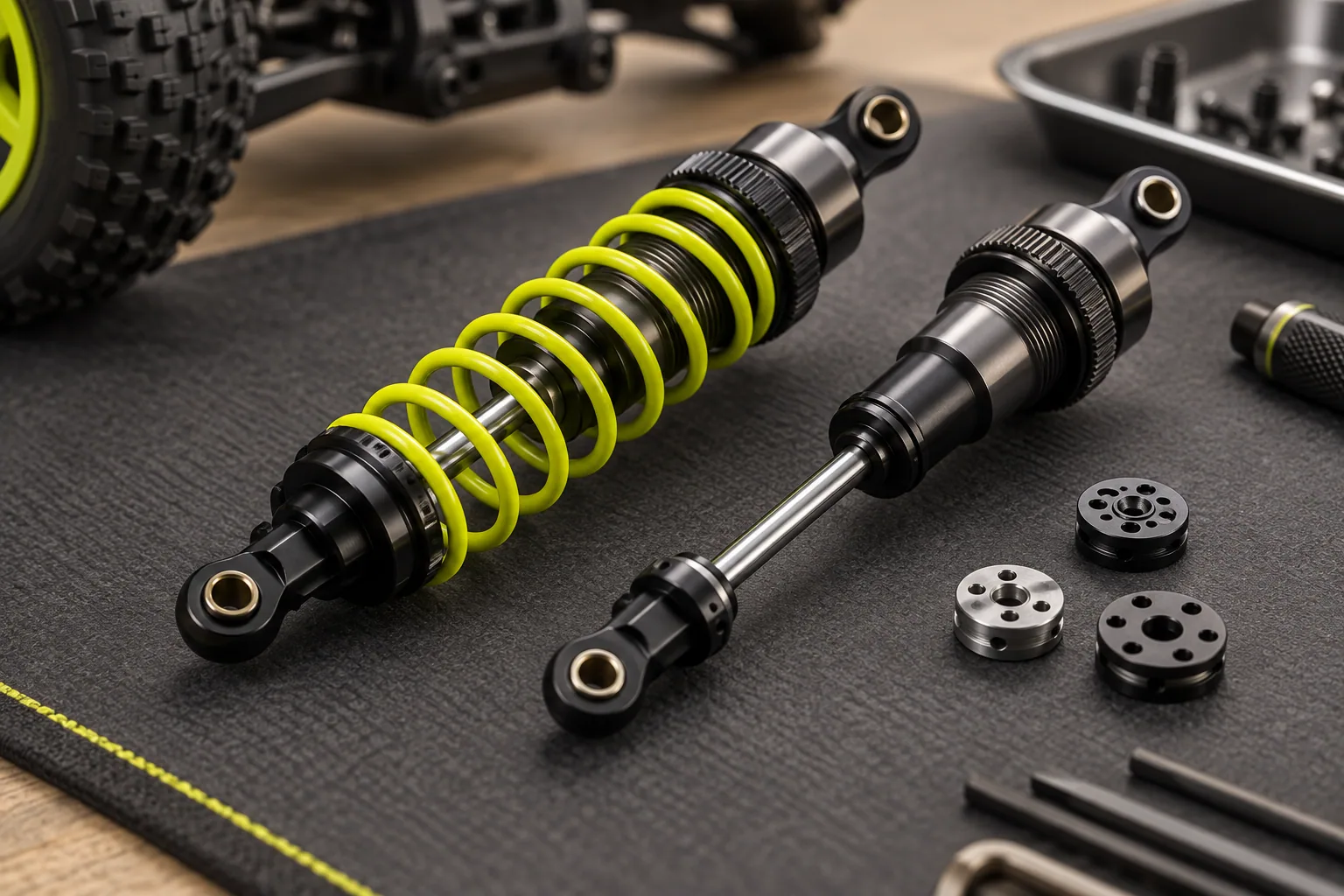
AI-generated concept illustration of generic RC dampers, a coil spring and spare pistons.
AI concept illustrationProvenance ↗
CUTAWAY / RELATIVE FLOW

Change the path, not the physics claim.

Traxxas describes damping as a piston displacing oil in a cylinder: more/larger piston holes allow oil through more easily, while higher-viscosity oil increases damping. This visual preserves that direction without assigning a force, grip gain or CFD flow field. Traxxas suspension guide ↗

Relative cutaway of an oil-filled RC shockA piston and shaft move together in an oil-filled shock body. Animated marks show one qualitative direction through piston holes when Play is selected. The cutaway is schematic, not a service drawing. OIL VOLUMEPISTON PATHSAME PISTON SPEEDQUALITATIVE FLOW / NOT FORCE

At the same illustrated piston speed, thinner relative fluid and an open piston path create the least restricted comparison in this schematic.

Compare a single path

Relative fluid viscosity
Relative piston path

Animation is opt-in and pauses for reduced-motion preferences. It illustrates relative path restriction only.

CURRENT READING

Thinner fluid + open path

At the same illustrated piston speed, this is the least restricted comparison here. It is not a measured damping force and not a recommendation.

VISCOSITY

Use units carefully.

Centistokes (cSt) is a kinematic-viscosity unit. A bottle’s “wt” label is a brand-specific naming convention, so this lab does not provide a universal wt-to-cSt conversion table. Record the brand, label and, where supplied, cSt/temperature information together.

TEMPERATURE

Keep the condition with the note.

Viscosity changes with temperature. A cold-to-warm session can therefore feel different even when the bottle and piston do not change. This is why a setup note should include conditions, not just the label on the oil.

PISTON + BUILD

Oil is not alone.

The piston path and a correctly built, bled shock are separate variables. A TLR assembly manual instructs drivers to work the shaft to release air bubbles and compare paired shocks for even compression and rebound. TLR shock assembly manual ↗

HOW TO CHOOSE / A SAFE START

Start with the exact manual.

  1. Identify the exact vehicle, shock family and current piston/build—not merely the scale or a similarly named platform.
  2. Read the model’s manual for manufacturer-approved shock oil and its stock piston/setup. Some manuals explicitly tie shock tuning to both fluid viscosity and piston choice. Traxxas owner manual ↗
  3. Describe the use case and body format: smooth or rough surface, jump/impact frequency, vehicle response, temperature and whether front/rear are being kept distinct.
  4. Make one documented, manual-compatible change at a time; rebuild and bleed consistently; compare a repeatable run.
  5. Use the result to decide whether to restore the baseline or consult the manual/support documentation—not a generic oil-weight prescription.
What this schematic assumes—and leaves out

The piston travels at a constant, identical illustrated speed in all four states. “Thinner/thicker” and “open/restricted” are relative labels only. The drawing does not model viscosity values, temperature curves, pressure, cavitation, seals, bladder/emulsion behavior, shaft speed, spring rate, leverage ratio, tire, terrain, temperature or vehicle motion. It does not predict damping force, traction, ride height or safety.